Luxury Living On The River Of Kings

ICONSIAM Superlux Residence is proud to announce the launch of The Residences at Mandarin Oriental, Bangkok. This project marks the hotel group’s seventh residence project worldwide and its first in Southeast Asia. The newly unveiled project offers unparalleled luxury accommodation coupled with the renowned style, service and excellence for which Mandarin Oriental is known.

With the opening of The Residences at Mandarin Oriental, Bangkok, located diagonally across the Chao Phraya River from the hotel, you can enjoy a more permanent stay under this iconic brand. As the most recent addition to the innovative ICONSIAM megacomplex—a new landmark addition to Thailand’s capital, which plays host to The Residences— Magnolia Development Corporation provides everything required for a new standard of luxury living realized through its pioneering vision.

A Harmony of Modern and Traditional

The Residences are comprised of 146 exclusive units and amenities across 52 floors, designed by renowned Joyce Wang Studio, which has put its unique stamp on landmark luxury hotels, residences and restaurants in major cities, including Las Vegas, Vancouver, Shanghai and Hong Kong. This latest project, the studio’s first in Bangkok, secured the South East Asia Property Awards 2016 for best residential interior design.

The building itself—one of the tallest in the city—with its grand entrance and lobby, was inspired by traditional Bangkok architecture as well as the form of the Chao Phraya River, which teems with traditional and modern life beside the Residences. Great attention to detail has been paid throughout the property, with top-quality wood, stone and metal structures designed and built in concert with space and light.

The lavishly designed structure is tastefully decorated with selected antiques, custom artworks and the finest local artisanal crafts, all handpicked to blend harmoniously with the building’s architectural style.

Much more than an architectural and artistic showpiece, the Residences were carefully conceived to foster a sense of community with social spaces and other beautiful communal areas open to all residents, including more than 1,600 square meters of gardens.

It all starts on the ground floor, with the impressive Grand Residential Lobby, the Chao Phraya Lounge (also available for private functions) and the Mandarin Gallery lounge area.

The 4th and 5th floors are dedicated to the River Clubhouse facilities, featuring the River Terrace with an outdoor lawn area and sunbathing deck, an outdoor infinity pool, jacuzzi, sauna and steam room, and barbecue terrace, as well as the Garden Loft dining area and kitchen. For the kids, a children’s pool and an indoor and outdoor playroom are on offer.

Other facilities to keep the family pleasantly engaged include a golf simulator and a game room, as well as a private fitness and wellness studio and a fully equipped gym.

On the 36th floor is the Sky Pavilion, which includes the Oriental Salon, a formal lounge and the Siam Salon function room (also available for private functions).

Luxury Residences to Suit Your Lifestyle

Each freehold condominium unit has been designed to enhance its inhabitants’ lifestyle and privacy. There is a selection of varying dimensions and layouts, all featuring uninterrupted views of the Chao Phraya “River of Kings.” All units are available fully furnished.

The 2-bedroom units range from 128 to 165 square meters, while 3-bedroom units are of 222 to 228 square meters. Both configurations include generously sized bedrooms and central living areas.

Ultra-luxury penthouses range from 385-square-meter residences to two-story, 710-square-meter units, featuring private lifts and spectacularly large living spaces, with ceilings more than three meters high, natural light and incredible views of the river and the Thai capital far below.

A range of amenities are available to residents, such as around-the-clock concierge services provided by trained Mandarin Oriental staff. Owners are invited to join the Residences Elite Programme to enjoy bespoke benefits while at home, and VIP recognition and benefits while staying at any Mandarin Oriental property around the world.

Located on the banks of the Chao Phraya River, the THB54 billion (US$1.8 billion) ICONSIAM megacomplex has broken new ground with its dining, entertainment, leisure, cultural and shopping opportunities.

Since its opening, ICONSIAM has changed perceptions of what constitutes the city center of present-day Bangkok, by bringing vibrant life back to the banks of the river where the city was originally founded. While being easily accessible by road, river and rail, the upcoming gold line monorail link, scheduled to open next year, also offers an alternative route to the location.

The 20-acre site features spectacular water and fire installations along 400 meters of parkland riverfront, where the public can relax and watch the river flow. Here, modern international lifestyle joins hands with Thai tradition. This pioneering 10-story space provides the best the country has to offer, and since its opening late last year has been attracting countless local and international visitors to shop and enjoy Thai culture.

Offerings include movie and live theaters, a full range of international brand shops across 525,000 square meters of retail floor space, an indoor floating market, a mind-boggling selection of local and international cuisine, and the River Museum, a joint venture with the Ministry of Culture’s Fine Arts Department. The enormous complex includes the Magnolia Residences as well as a Hilton hotel.

And now, with The Residences at Mandarin Oriental, Bangkok, the ICONSIAM project is complete; a comprehensive luxury lifestyle is available entirely onsite that caters to residents’ needs and desires.


For more information about
The Residences at Mandarin Oriental, Bangkok,
please visit:
www.moresidencesbangkok.com

Sales Representative Contact:
Tel: +66 2 012 4555
Email: sales@moresidencesbangkok.com

Frasers Property: Building Multinational Real Estate Platforms

One Bangkok

Over the years, Frasers Property has evolved into a multinational real estate company that owns, develops and manages a diverse, integrated portfolio of properties covering five asset classes and six REITs. Listed on the Singapore Exchange, the group’s S$33.6 billion (US$24.5 billion) in assets range from residential, retail, commercial and business parks, to industrial and logistics in Southeast Asia, Australia, Europe and China. It is also well-established in the hospitality business, where it owns and operates serviced apartments and hotels in over 70 cities.

This year, Frasers Property has focused its efforts on building a resilient and sustainable business, specifically by building up some of its key platforms.

An Integrated Industrial and Logistics Platform

In October, the group formed an integrated industrial and logistics platform, Frasers Property Industrial, combining its industrial and logistics operations in Australia and Europe that represent about S$5.4 billion (US$3.9 billion) in assets under management. Frasers Property Industrial offers modern, sustainable industrial real estate including logistics facilities, warehouses and production facilities in strategic locations across Europe and Australia. The integrated unit is also actively leveraging its strong connection with the group’s operations in Thailand, where Frasers Property Thailand is one of the nation’s largest industrial and logistics operators.

Creating Scale in Thailand

In recent months, Frasers Property Thailand completed its acquisition of 94.5% of shares in Golden Land Property Development Plc. This acquisition is an important milestone in its journey in Thailand as the two leading real estate developers come together to become a leading integrated real estate platform in Thailand, giving Frasers Property a balanced and diversified property portfolio spanning across industrial and logistics, residential, commercial and hospitality.

Frasers Property Holdings Thailand is the development manager for One Bangkok. When completed, One Bangkok is anticipated to be Thailand’s largest fully integrated district, and the group sees it becoming a new global landmark.

The group’s capabilities in mixed-use developments are not limited only to Thailand. In Singapore, its mixed-used development portfolio includes Northpoint City, which is the group’s first suburban mall as well as the largest integrated development in the north of Singapore.

Central Park Sydney

In Sydney, its Central Park development’s iconic and globally award-winning architecture with public green spaces have transformed the city’s downtown since the complex’s launch in 2014.

A Leading Retail Operator in Singapore

Its retail business has also been growing rapidly. A recent move to develop a retail focused platform to realize its aspirations in Singapore demonstrates its intent to build meaningful scale in a fast-evolving local retail landscape. Frasers Property Retail has assets valued at more than S$8 billion (US$5.8 billion), which includes its retail assets across Frasers Property Singapore, its REIT, Frasers Centrepoint Trust, and the group’s strategic investments in PGIM Real Estate AsiaRetail Fund. Its retail properties are located in populous residential areas that enjoy good connectivity to Singapore’s public transportation system, giving its properties a stable footfall and healthy mall occupancy.

“Frasers Property aspires to be a world-class, multinational owner-operator-developer of real estate products in resilient markets and a provider of real estate services, complementary to our investments. As we continue to strengthen our platforms in a rapidly evolving real estate industry, we will seek ways to redefine experiences for our customers,” says Panote Sirivadhanabhakdi, Group Chief Executive Officer of Frasers Property Limited.

Hong Kong: A Beacon For Meetings And Events

An aerial night view of Hong Kong.

For companies looking to expand their business into Asia, Hong Kong has long made sense as a good first step. With a common law framework and well-developed infrastructure, Hong Kong offers fertile ground as firms pursue reach across the region.

Its accessibility—the Special Administrative Region is within a five-hour flight for half of the world’s population—is unparalleled. A number of international businesses base their regional operations out of Hong Kong, providing abundant opportunities for networking and connectivity. And its top-class convention and exhibition spaces are some of the most attractive and well-run in the region. No wonder Hong Kong has for decades been recognized as Asia’s leading destination for meetings, exhibitions, conferences and events, an industry commonly known as MICE.

As Hong Kong’s reputation as the region’s go-to destination for MICE events soared, the range of exceptional venues to hold them has morphed. The Hong Kong Convention and Exhibition Centre (HKCEC) remains the choice venue for international events and consistently wins “Asia’s Best” awards—despite intensifying competition in the region—for its service excellence, professionalism and experience in hosting world-class events. The HKCEC is now home to three of the world’s largest, and five of Asia’s biggest, trade exhibitions. World-class fairs such as Art Basel Hong Kong, Vinexpo Hong Kong and Cosmoprof Asia populate HKCEC’s packed calendar.

Having scooped more than 50 major awards in the space of 14 years, Asia- World-Expo has emerged as a leading exhibition and convention venue in Asia, hosting a high-profile and diverse roster, including the Global Sources Trade Fair, the Hong Kong Masters equestrian event, Asia Pacific Life Insurance Congress 2019 and Hong Kong Fintech Week 2019.

The Hong Kong International Trade and Exhibition Centre in Kowloon Bay brings a third impressive option to this vibrant mix, as well as six-star hotels with their own cutting-edge conferencing facilities. Add to this the work of a dedicated event-planning partner, Meetings and Exhibitions Hong Kong of the Hong Kong Tourism Board. Members work tirelessly to aid organizers in designing smooth-running events, from being a super-connector with local trade partners to assisting with hotel bookings and bid proposals, to coordinating hospitality and trade offers, to even arranging dedicated immigration counters at Hong Kong International Airport for mega MICE events. Their experience ensures highly tailored meetings and events move flawlessly from vision to reality.

The 2019 Index of Economic Freedom has ranked Hong Kong the world’s freest economy for the 25th consecutive year. In 2018, Hong Kong was awarded “World’s Leading Business Travel Destination” and “Asia’s Leading Meetings and Conference Destination,” at the World Travel Awards, and “Best City for Meetings in Asia” by Smart Travel Asia. The numbers illustrate Hong Kong’s attraction as a premier MICE destination. In total, 2.3 million visitors participated in “trade” and “trade and consumer” exhibitions in 2018, and more than 69,000 exhibiting companies came to Hong Kong to strengthen their business opportunities.

Hong Kong’s global free port continues to thrive on the free flow of goods, services and capital, and the city remains a rock-solid destination for those wishing to host outstanding exhibitions and events.


ICBC: Leading The Way In Private Banking In China

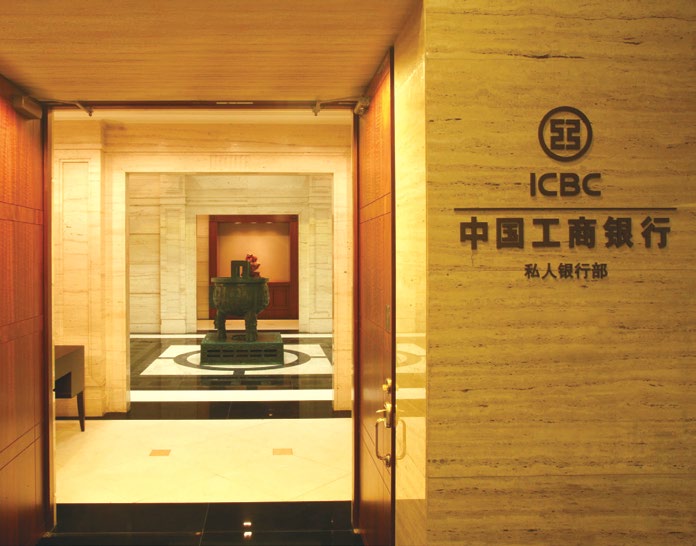
ICBC Private Banking’s headquarters in Shanghai

Industrial and Commercial Bank of China Limited (ICBC) has grown its private banking business over the past decade to become one of the leading players in China, with an expanding presence abroad. Headquartered on the banks of Shanghai’s historical Huangpu River, ICBC became the first financial institution to be granted a license specializing in the private banking business by the China Banking Regulatory Commission in 2008.

Since then, the bank’s private banking team has developed assets under management (AUM) to more than RMB 1 trillion (US$145.05 billion) as it capitalized on the country’s rapidly growing wealth in that period.

As of the end of June, ICBC Private Banking’s AUM stands at 1.6 trillion RMB (US$232.08 billion). It serves more than 90,000 high-net-worth clients and 400 service institutions, covering main cities and regions in mainland China. Internationally, the private bank has established sub-branches in more than 20 countries and regions, forming a global network in Asia, Europe, North and South America as well as in Australia and New Zealand. 

Exclusive and Integrated Services

As part of a global banking group, ICBC Private Banking is able to leverage on the integrated resources of the entire bank—from investment banking and corporate finance to credit cards and insurance—to offer a holistic service and better meet the increasingly complex needs of its clients.

Internally, ICBC Private Banking continues to build its brand by adding new exclusive services, such as concierge services and emergency assistance, that are designed to serve its clients’ needs in a wide range of areas, including healthcare, education and business travel.

Embracing a Digital Strategy

ICBC Private Banking is also investing in fintech solutions such as big data and artificial intelligence to improve efficiency and customer service. For instance, it offers an AI-advisor service that helps financial advisors quickly provide clients with investment portfolio and asset allocation strategies.

Meanwhile, ICBC’s various online and mobile services platforms help to deepen and improve the interaction between HNWI clients and the bank, promoting security and efficiency in the process.

Committed to Philanthropy

Throughout its growth journey, ICBC Private Banking has been committed to giving back to the less privileged in the community. Last year, for instance, it collaborated with clients to promote better living conditions for children in remote regions. Together with professional charitable foundations, ICBC Private Banking raised money to donate water heaters to nearly 50 primary and secondary schools in Sichuan province.

Grooming Talent

Over the years, ICBC Private Banking has built a team of professional talent with the necessary knowledge and skill sets to serve the high-net-worth segment in China. To achieve this, it has put in place a training system that caters to different levels of expertise. The system is made up of various components—including online classes, remote learning platforms, case studies and overseas training opportunities—to help its people develop transferrable skills.

Leveraging both internal and external resources, ICBC Private Banking will continue to develop its services platforms across markets, institutions and products, and provide its clients with exclusive services with integrity, professionalism and passion.


https://www.icbc.com.cn/ICBC/EN/Others/PrivateBanking/default.htm

Malaysia: Moving Ahead

Kuala Lumpur, Malaysia

Malaysia continues to be on an upward trend, with Bank Negara Malaysia noting that, amid rising external headwinds, the country’s economy remains on a steady growth path in 2019.

The central bank observed that the economy recorded a stronger growth of 4.9% in the second quarter compared to 4.5% in the first quarter, supported by higher household spending and private investment. Growth is expected to remain supported by private sector activity while Malaysia’s growth performance remains resilient.

As a bellwether of upbeat sentiments experienced by Malaysian companies, the Malaysia Convention & Exhibition Bureau (MyCEB) reports that inbound events alone brought in an estimated US$380 million contribution to the country’s economy. In 2020, Malaysia will launch Visit Malaysia 2020 (VM 2020), a tourism campaign that aims to bring in 30 million tourist arrivals and US$24 billion in tourist receipts. “In line with the campaign, we have to date lined up 38 business events that will bring in around 49,000 delegates, mostly from the healthcare, telecommunications, science and technology industries,” says Datuk Zulkefli Hj. Sharif, CEO of MyCEB.

The ability to attract international participation to its shores is not Malaysia’s only strength, however. Large conglomerates such as Top Glove, Silverlake Axis and Serba Dinamik are prime examples of how Malaysian companies have successfully ventured abroad.

Top Glove continues to be the largest rubber glove maker in the world, accounting for 26% of the global market share, and has ambitions to grow this figure to 30% by 2020. Silverlake Axis is looking to aggressively grow its customer base this year, as it aims to be in many more markets by mid-2020. The company recorded a 26% jump in revenue to US$162.23 million, while net profit jumped 83% to US$58.52 million in its latest full-year report.

And Serba Dinamik, an oil and gas maintenance, repair and overhaul services operator, has recently expanded to Uzbekistan, the United Arab Emirates and Qatar. Its revenue has also more than quadrupled from US$180 million in 2014 to US$780 million in 2018, and the company today has a market capitalization of approximately US$1.47 billion.

But revenue and profitability aren’t the only measures of success for Malaysian companies.

BookDoc’s founder and CEO Dato’ Chevy Beh believes a progressive country is measured by how its healthcare system functions. This is why the four-year-old startup aims to bring connected digital healthcare to the masses by integrating technology into every facet of human life.

“In the healthcare realm, going digital means having your healthcare services available anytime and anywhere, and making these services work for you the way you want them to,” he says.

Moving forward, Bank Negara Malaysia Governor Datuk Nor Shamsiah Mohd Yunus is confident that the Malaysian economy will remain on a steady growth path. She said the external sector is likely to continue to be affected by slower global growth amid ongoing trade tensions but the overall baseline projection is for the Malaysian economy to grow by between 4.3% and 4.8% in 2019.

UOB Research said the government is likely to continue efforts to restore public finances and good governance, which will help the country find balance during volatile times. The country will likely adopt more cost-effective ways of spending and ensure sufficient fiscal buffers are in place, the firm added.

The Philippines In 2019: Resilient And Rising

Manila skyline

Coming off GDP growth of 6.2% in 2018, the Philippines has impressively maintained positive momentum in the face of a global economic slowdown and geopolitical tensions. The World Bank, Asian Development Bank and IMF have all maintained projections of the Philippines as one of the region’s fastest-growing economies into 2020.

The Department of Finance cites strong macroeconomic fundamentals and judicious fiscal and tax reforms as reasons for the country’s strong performance. Its debt-to-GDP ratio is dropping, gross international reserves are rising and the Philippine peso is among Asia’s best-performing currencies. This prompted financial analytics firms such as S&P Global to upgrade the country’s credit rating to “BBB+” with a stable outlook.

Steady economic confidence is evidenced by foreign direct investments doubling and consumer demand accelerating to 6% in 2019 versus the same period last year. Major infrastructure projects are on track, boosting related industries. Philippine firms such as port-handling titan International Container Terminal Services, Inc (ICTSI) are contributing to the government’s ambitious “Build, Build, Build” program by helping improve trade logistics and investing in human capital. Its Chairman and CEO Enrique Razon Jr. says that, as global manufacturing and production shifts, the country can capitalize on available opportunities.

The Philippine property market is set to reach double-digit growth this year, with real estate values hitting historic highs, according to Leechiu Property Consultants. With the country accounting for 16-18% of the estimated global information technology business process management revenue market, offshoring and outsourcing demonstrate strong, stable demand. Jones Lang LaSalle projects growth of 7-8% in 2019 for the contact center industry alone. Online gaming operators are the most recent and aggressive leaders of this gold rush. Vigorous take-up of office space and the burgeoning worker base have also fed a bullish residential market. Rising condominium prices, previously reliant on the local and overseas Filipino markets, are now increasingly driven by foreign investors and locators. Rental rates in key areas have risen by 80% in the last three years. Thriving online retail and logistics are driving demand in warehousing and industrial properties.

This boom is translating to solid performance by the country’s largest conglomerates, and many have successfully increased their presence abroad. SM Investments Corporation, cited in Forbes’ Global 2000 list of the World’s Best Regarded Companies, saw its income up by more than a quarter this year thanks to its banking and real estate holdings. ICTSI’s earnings, meanwhile, have increased by almost 50% in 2019.

Years of sustained growth coupled with increased investments are uplifting more Filipinos, translating to more jobs and better quality of life. Network marketing companies like FRONTROW are taking advantage of these conditions to achieve rapid success. Developers such as Vista Land, run by the country’s second richest tycoon, Manuel Villar Jr., are keeping pace by expanding with more innovative projects in key locations.

By overcoming and even making the most of regional challenges, the Philippines continues to rise in the ranks as a leading global economy.

HSBC Private Banking: Harnessing Asian Wealth Today For Tomorrow

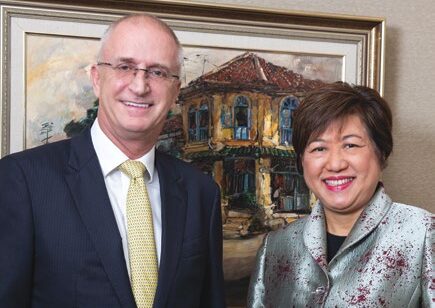
(Right) Siew Meng Tan, Regional Head of HSBC Private Banking, APAC; (Left) Philip Kunz, Head of HSBC Private Banking, Southeast Asia

Long-term survival takes courage, wisdom and flexibility. One of the biggest hurdles is readying a family business to pass on to the new generation, marrying the cornerstones of the business with new visions and practices.

Forging the right partnerships as these developments unfold is key. HSBC Private Banking understands what it takes to create companies that last generations. It has worked with family-run empires across Asia for 154 years and combines deep knowledge with global connectivity—benefits that few others can match. “The experience in having led actual generational transfer is an experience not every bank has,” says Siew Meng Tan, Regional Head of HSBC Private Banking, APAC.

Engineering Enduring Success

Through its trust company, Private Wealth Solutions, HSBC Private Banking offers tailored solutions for sustained wealth, helping families understand and shape a continued and prosperous legacy. HSBC Private Banking guides a company as it makes decisions on how to apportion wealth across a family network, or restructure the business for an evolving family and marketplace. “We advance prosperity for wealthy families with a desire and duty to succeed by helping them engage with the world outside their world,” says Philip Kunz, Head of HSBC Private Banking, Southeast Asia.

The second or third generation of entrepreneurial families may want to branch out and embark on their own endeavors. Over decades of working with ultra-high-net-worth clients, the bank has witnessed a desire in the younger family members to move beyond mere impact investing and has responded in innovative ways. Organized trips into the Borneo rainforest, for instance, provide clients with a first-hand look at environmental issues as well as actionable ideas for how they can make an impact on their businesses, investments and communities based on sustainable principles. Such expeditions resonate well with today’s rising entrepreneurs, says Tan, and often reveal further awakenings. “They provide additional insight into the role of sustainability in family businesses and family wealth,” Tan says.

Connecting to a World of Opportunity

HSBC Private Banking’s “one bank” approach ensures today’s global families are not limited to just local or regional geographies. HSBC Private Banking is one of the four global businesses around which the HSBC Group is structured, and its worldwide network affords clients accessibility across all corners of the globe. HSBC offers strong connectivity and collaboration across the bank to support even the most international and complex of client needs, whether family or business.

Imagine a Hong Kong family with ASEAN business interests. They easily transact in Singapore, Thailand and Malaysia for their business using commercial banking, while their personal wealth is managed by HSBC Private Banking in Hong Kong and Singapore. They have mortgages for their U.K. properties that are provided by HSBC Private Banking in the U.K., and their children study at U.S. universities supported by services from HSBC’s U.S. retail bank. This ease is a reality with HSBC Private Banking. Connectivity is seamless.

As part of a global universal bank, the advantage is clear. Through close collaboration, HSBC Private Banking provides its clients with the benefit of end-to-end solutions from across an entire portfolio of services, supplying specialist coverage for a client’s individual needs, no matter how complex. The bank is adept in tailor-made, winning solutions whatever the challenge.

Create a Lasting Legacy

With wealth in Asia rising at a faster rate than in any other region, ultra-high-net-worth clients increasingly require sophisticated and tailored solutions for investing, financing and hedging, and turn to HSBC Private Banking for guidance. Using an institutional approach, HSBC Private Banking connects clients to a wealth of opportunity, wherever they are in their succession plan, helping businesses to prosper today, tomorrow and long into the future.


The information contained in this article has not been reviewed in the light of your individual circumstances and is for information purposes only. It does not purport to provide legal, taxation or other advice and should not be taken as such. No client or other reader should act or refrain from acting on the basis of the content of this article without seeking specific professional advice.

Issued by The Hongkong and Shanghai Banking Corporation Limited.


Africa Aims To Replicate Asia’s Tech Revolution To Address Its Inefficiencies

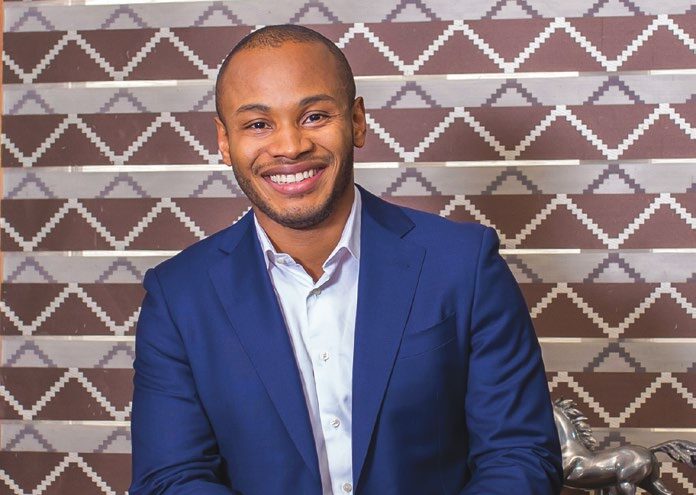
Mr. Ernest Ezenna, Business Development Director, Orange Group

Asia is familiar territory for the 33-year-old Ernest Ezenna, the Business Development Director of the Nigeria-based Orange Group (orangegroups.com), a family-owned fast-moving consumer goods (FMCG) business. The Group was established by his father, Sir Tony Ezenna, in 1988 after visiting Indonesia to strike partnerships with local top-tier pharmaceutical companies such as Kalbe Farma and PT Tempo Scan.

After graduating from Babson College in Boston, Ernest Enzenna spent two years in Asia; first learning Mandarin at Peking University, before working in Jakarta at Northstar Pacific, Indonesia’s premier private equity firm. Upon joining the family business, Ernest spearheaded the Group’s digitization initiative, as well as its investments in tech startups in Nigeria.

“The situation in Nigeria is similar to Indonesia—and much of Southeast Asia—20 years ago,” Ernest says. “We’ve got a large population, a lot of young people and an economy that’s transitioning from extractive industries to one that’s more services driven. The difference, however, is that we’re leveraging tech early in the process to jumpstart growth and address some of our everyday challenges. It’s an exciting time for tech in Africa, especially in Nigeria.”

The Economist Intelligence Unit reported Nigeria’s e-commerce market to be worth US$13 billion currently, with experts in the Nigerian financial services sector expecting this to hit US$50 billion in the next 10 years. Meanwhile, McKinsey Global Institute estimates that Nigeria’s economy will grow to US$1.6 trillion by 2030—propelling it into the world’s top 20. This growth, coupled with the nation’s population of around 200 million people, means that investors can’t ignore Nigeria.

Ernest believes that technology enables businesses in Nigeria to skip the ‘brick-and-mortar phase’ and scale up faster and cheaper, while minimizing exposure to certain operational hurdles. “The only way to reduce inefficiencies is to use technology. This tech disruption is occurring in the banking and logistics sector in Nigeria as we speak.” This has motivated Orange Group to begin investing in promising tech start-ups in the space, such as Carbon and Gokada.

New apps aiming to solve some of Africa’s bottlenecks

Disrupting Banking

Lagos-based Chijioke Dozie, co-founder of digital finance platform Carbon (app.getcarbon.co), says that Nigerian fintech start-ups have big potential beyond the country’s borders. “When you consider that these solutions are being built and honed in some of the most hostile business environments in the world, and seeing incredible traction, you have to ask how soon we should expect to see these solutions in markets outside Africa,” Dozie told FinTech Magazine.

“Penetration is low for Nigerian banks, compared to mobile phone subscribers. Fintech will take off faster. It makes sense to offer financial services through apps, over bank branches,” he said.

Chijioke, 40, is a Harvard-trained wunderkind who is making waves in the fintech space. His Carbon app offers credit, simple payments, high-yield investment opportunities and personal financial management tools aimed at the unbanked. It has 1.5 million downloads and completes more than 5,000 loans a day.

Carbon developed a machine-learning tool to calculate credit-worthiness for customers without credit histories, opening the door to, among others, the 60% of Nigerians working in the informal labor market.

Carbon secured US$13 million in Series A funding earlier this year. The start-up plans to launch the app in Kenya in Q4 2019, and is also targeting Egypt, Ghana and Ivory Coast for likely future rollouts.

Orange Group’s belief in Carbon’s ability to disrupt Nigeria’s banking sector motivated the Group to invest US$600,000 in Carbon’s convertible bond, which was raised before pursuing its recent Series B round later in the year.

Passenger hailing a Gokada ride

Disrupting Logistics

Also on Orange Group’s shortlist is Ayodeji Adewunmi, President and Co-CEO of Lagos-based motorcycle ride-hailing app Gokada (gokada.ng). Drawing inspiration from Indonesian unicorn Gojek, Gokada is based in Lagos, which has 25 million people, most of whom are eager to avoid the city’s horrendous traffic jams.

Adewunmi is targeting to book a million rides a month by late 2019. “Lagos is at the cusp of regulating the ride-hailing ecosystem. This is a critical infrastructure, and will be important to further boost investor confidence.”

His long-term strategy is to expand the app from mobility to include on-demand and financial services. Adewunmi understands that Gokada will need a laser focus on customer demand to realize a potential market of US$2 billion in Nigeria, and US$15 billion across Africa.

“Safety is the No. 1 priority and the city is the No. 1 customer,” Adewunmi says. Reflecting his commitment to this ethos, Gokada shut down for a week in late August to retrain all its riders after his Co-CEO had a bad experience with the app.

Gokada raised US$5.4 million in Series A funding in early 2019, including US$300,000 from Orange Group. Adewunmi said Gokada is more than halfway to completing its planned Series B funding by Q1 2020.

Disrupting FMCG Distribution

At Orange Group, meanwhile, Ernest plans to disrupt a different segment: FMCG distribution. The Group is a major local player, having specialized in manufacturing and distributing personal care and pharmaceutical products for over 30 years. He spearheaded the development of the Orange Business Intelligence Technology (ORBIT), a cloud-based retail coverage system. The platform was conceived in 2017, developed by Houston-based developers TuiSpace, and launched in early 2019.

ORBIT is a tool that allows FMCG companies to have visibility on their brand presence in various retail outlets across the country. It was explicitly designed for the chaotic and opaque local market, Ernest says. “FMCG distribution in Nigeria requires tighter controls on the field team’s ability to ensure shelf presence.”

Currently, ORBIT allows for real-time visibility across 23,000 retail outlets. The dataset is compiled by field teams going from street to street in three big cities to map everything from big-box retailers to street-side stands. The teams return to the same retail points on a weekly to monthly basis to check brand shelf presence, and then input the data into ORBIT.

Through the cloud, brand managers in Lagos are able to see how their brands are distributed, store by store. In Indonesia, Kalbe is beta-testing ORBIT to manage the distribution of its brands in Nigeria.

With over 1 million retail outlets in Nigeria selling FMCG products, based on Nielsen’s estimates, Ernest plans to expand ORBIT’s outlet base from a mere 1% currently to at least 70% of retail coverage in five years. Moreover, he aims to expand the Group’s pool of potential FMCG clients. “ORBIT is cloud-based, transparent and customized to one of the world’s most fragmented retail markets. It’s a game-changer for firms looking to access Africa’s largest FMCG market.”

Ernest continues to believe in the potential of partnerships and shared learnings between Asia and Africa, especially in the tech space. This has been one of the guiding principles at Orange Group and one that is likely to set it apart from others on the continent.


Singapore: Transcending The Turbulence

Amid persistent trade tensions and weakness in the global manufacturing sector, Singapore is facing headwinds on multiple fronts. Even as the city-state braces for the challenges ahead, however, it continues to attract strong investment as firms continue to put their faith in the strengths of this international business and financial center.

After all, Singapore’s own story as a city-state has shown its ability to transcend the uncertainty in the global economy and adapt to an evolving landscape, continuing to present itself as a safe haven for investment and business.

Multinational corporations and homegrown companies from a range of industries are leveraging Singapore’s strengths of geography, ease of doing business and support for innovation to forge ahead with their expansion plans in the face of an uncertain landscape.

Leading real estate developers are rolling out daring new residences that are redefining luxury living in the city. For instance, City Developments Limited has unveiled three new premiums condominiums–Boulevard 88, South Beach Residences and Nouvel 18–in some of the city’s most sought-after neighbourhoods.

Another stunning development in downtown Singapore, Marina One Residences in the heart of vibrant Marina Bay, launched its second tower earlier this year. This unique project by developer M+S was conceived through a historic collaboration between the Malaysian and Singaporean governments.

On the hospitality front, icons are being reborn even as new brands enter the market. Raffles Hotel Singapore reopened this year after a major restoration, reinvigorating a historic landmark with a heritage that stretches back over a hundred years. Meanwhile, The Ascott Limited is shaking up the industry by launching its largest co-living property in Southeast Asia in Singapore, the first under its lyf brand of co-living properties designed for millennial and millennial-minded travellers.

Another leading hospitality player, Pan Pacific Hotels Group (PPHG), continues to expand its portfolio of properties in Singapore and around the world as it brings its signature brand of sincere hospitality to more markets. The group aims to be a leader in sustainability, with its upcoming property, Pan Pacific Orchard, designed to be its first zero-waste hotel.

From its regional base in Singapore, luxury car maker Jaguar Land Rover is also upping its game in terms of innovation and service levels across 17 markets in Asia as it taps into the rising affluence in the region’s dynamic economies. The recent relaunch of one of its most iconic vehicles, the Land Rover Defender, is set to make a splash among car buyers in this part of the world.

But it’s not only multinational corporations that are capitalizing on Singapore’s advantages. One of the country’s most successful brands, traditional Chinese medicine giant Eu Yan Sang, is reinventing itself for the digital age 140 years after its founding.

Supporting these enterprises are Singapore government agencies like Infocomm Media Development Authority (IMDA), which is developing a robust ecosystem for companies to thrive in a rapidly digitalizing economy. Among other initiatives, the agency is working with industry partners to facilitate the development of applications that leverage ultra-fast 5G wireless networks.

The path ahead remains rocky for the foreseeable future, but in these challenging times businesses around the world are banking on Singapore’s stability and proven success in navigating crises to accelerate their growth journeys.

Banking On Diversity

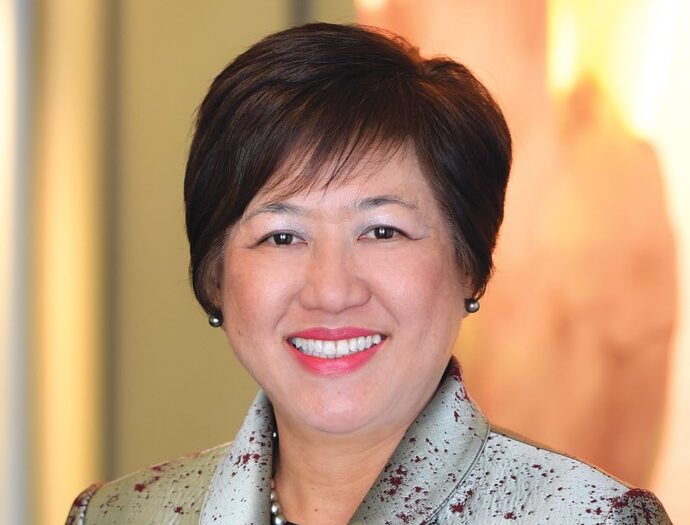
Siew Meng Tan, Regional Head of HSBC Private Banking in Asia-Pacific

Q: You joined HSBC 14 years ago—from starting out in corporate banking in Singapore to taking on the CEO role in Mauritius and Thailand, and now you’re the Regional Head of HSBC Private Banking in Asia-Pacific. What are some of the biggest challenges you’ve encountered in taking up a leadership role in the highly competitive finance industry?

It’s no secret that the finance industry is traditionally male-dominated, so there have been times in my career where I’ve had to work very hard on being visible and ensuring my voice is heard. The way I look at it, I always pursue roles that I enjoy so it makes it easier to transition from one position to another. Having the right drive and confidence has helped me to put myself forward and speak up. Rather than seeing them as a challenge, I look at every new assignment as a great learning experience. For example, moving from Singapore, known for having comprehensive regulations versus other countries that may be less so, I had to navigate through that as well as learn how to deal with different people from different cultures so it taught me a lot. In those roles—be it in Hong Kong, Mauritius, Singapore or Thailand—the common thread has been the opportunity for me to interact with clients to understand their businesses and needs in order to serve them better.

Why is gender diversity important in business? How does it benefit your clients?

Having led teams for a long time, I found that when you work with diverse teams—be it gender, nationality or background—you’re going to get more creative ideas and different perspectives in looking at things. And when your business is about finding solutions, diversity becomes even more important.

As for private banking in particular, it’s critical to have a diverse team because we’re dealing with very successful individuals and families, and increasingly more women who might prefer dealing with and learning from other women. Having diversity at our end ensures we are able to better cater for all our clients by having the right people to engage with them, be it different gender or individuals with different communication styles. It’s about having the right level of chemistry and, more importantly, trust.

What are you and HSBC management doing to promote gender diversity in the company?

As a group, we have given ourselves a target of 30% in terms of female leadership where it currently stands at 28%. However, in our private banking division, women account for 45% of the leadership posts at the moment. It is a good position to be in but ideally we’d like to set to 50-50.

It all starts with hiring where we are making a conscious effort to ensure that every time we create a shortlist of candidates to interview, it is balanced and well-represented. Same goes for when we’re considering promotions within the company as we don’t want to just leave it to chance.

We’re also looking at providing the younger female talents more opportunities through programs where they have mentors or sponsors, to make sure they get any support they may need to progress their career.

“We’re also looking at providing the younger female talents more opportunities through programs where they have mentors or sponsors, to make sure they get any support they may need to progress their career.”

– Siew Meng Tan, Regional Head of HSBC Private Banking in Asia-Pacific

In what ways does HSBC Private Banking support women entrepreneurs and business leaders?

I believe we’re in a very fortunate place to support women entrepreneurs and we do that through programs that aim to engage and educate our clients.

Last year we hosted a forum called ‘Invest Like A Woman’ where we invited successful female leaders in the investment space—CIO’s, portfolio managers at big fund houses—to speak and share their experiences and insights with our clients. The audience was a mix of women and men whom we feel are important to include in the conversation so that they may be more supportive of their children, siblings and spouses.

We also hosted our thought-leadership Women’s Forum earlier this year where we invited successful women leaders to share their insights and inspiring stories in driving transformation across various industries. We found that creating this kind of platform to share not just successes but also challenges resonates really well with clients.

This year HSBC Private Banking has also put its support behind AllBright, a networking club for women, with the aim of connecting and supporting entrepreneurial women. While they started in London, they are quickly expanding across the US and now looking at Asia. And HSBC is well-placed given our global footprint, our in-house expertise and our connectivity to contribute to the development of these future leaders.

One of the challenges aspiring entrepreneurs face is funding. This is where we come in with guidance on how to better attract investors. Same goes for the younger generation of family business leaders who might want to step out and set up a new venture, or need advice to better manage their family business and family wealth.

What advice would you share with other young female managers and entrepreneurs today?

My advice is that if you want to be successful it has to be a continuous learning process. I personally continue to learn and draw inspiration from successful women, who have made remarkable achievements in driving change and transformation on an individual, business and community level as well as striking the work-family balance. Speaking with them, you’ll be amazed at how each one has a different formula to success and ways to overcome challenges that they face.

I also believe that another key to success for everyone, regardless of their gender, is to be driven by passion for what they’re doing, which will eventually turn challenges into opportunities.

For me personally, what keeps me happy is the fact that I enjoy the role I can play in the banking industry, whether it is seeing development opportunities for my team or working with clients to support their ambitions.


The information contained in this article has not been reviewed in the light of your individual circumstances and is for information purposes only. It does not purport to provide legal, taxation or other advice and should not be taken as such. No client or other reader should act or refrain from acting on the basis of the content of this article without seeking specific professional advice.

Issued by The Hongkong and Shanghai Banking Corporation Limited.