Leading Travel Forward: Innovation, Impact And Vision

Jane Sun, CEO of Trip.com Group

For over two decades, Jane Sun has been building a global travel powerhouse and a force for change.

Under her stewardship, Trip.com Group has become a global travel leader listed on both Nasdaq and HKEX. Yet beyond the numbers, Sun is driven by a larger purpose: to pursue the perfect trip for everyone and for a better world.

Scaling a Global Vision

Sun came on board as CFO in 2005, at a time when Trip.com Group was still finding its footing on Wall Street, valued between US$500 million to US$1 billion. “We were quite small then,” she recalls. “Few investors fully understood our potential, so I told the board we needed to prove ourselves—by building a strong reputation and becoming a respected global player.”

Sun pursued that vision with tireless dedication, packing her schedule with back-to back meetings and relentless travel. Hopping from a quarterly earnings call at the airport straight onto a cross continental flight to meet with investors was a normal day. She had no time for jet lag, often taking only a quick shower on arrival before a full day of meetings—and by evening, heading straight back to the airport to do it all again at her next destination.

That hard work paid off. Within a couple of years, Trip.com Group was high on the radar of most investors. Today, the company is worth around US$50 billion, with more than 40,000 employees worldwide. Its platforms connect travelers with more than 1.5 million hotels and over 600 airlines, serving customers worldwide in more than 30 languages.

Yet those numbers tell only part of the story. Sun is driven to create meaningful impact—across business, communities and society. From pioneering innovative programs to supporting education and community initiatives, she seeks to open doors for others and drive lasting change. And, as one of the few women at the helm of a technology company, she has championed inclusive leadership and policies that empower people to realize their potential. 

Two decades on, Sun’s journey inspires leaders everywhere—and she’s just getting started.

Bridging Cultures, Driving Innovation

At the age of 19, Sun moved to the U.S. for undergraduate studies at the University of Florida, where she also began her career. Early international experiences shaped her global perspective—an outlook that would later guide her in building and leading an international business.

“My background allows me to bridge diverse cultures with a scientific management style,” Sun says. “It has given our team the tools to thrive in a global environment.”

Drawing on this perspective, Sun has shaped a management approach that combines rigor with passion. Under her leadership, Trip.com Group adopted Six Sigma and other data-driven management methodologies early, continuously invested in technology and fostered a culture where employees are encouraged to challenge ideas and innovate. Programs like “Baby Tiger” empower young employees to pitch entrepreneurial ideas, with funding to bring the best initiatives to life.

This combination has helped the company remain at the cutting edge of innovation and retain talent throughout major transitions— from offline to online, desktop to mobile, and now, with the advent of AI, from booking to discovery.

For Sun, innovation is not simply about keeping up with the latest technologies, it’s about delivering better experiences for customers. That approach has underpinned Trip.com Group’s investments from day one.

“When I joined the company, we were pioneering a centralized call center model while others were still opening retail stores on major streets,” Sun recalls. As booking online became the norm, Trip.com Group quickly became the trusted companion for millions of travelers, its ease of use complemented by industry-leading customer support. A few years later, the company was at the forefront of making the travel experience more accessible and intuitive, pioneering a “mobile-first” approach that put planning, booking and managing trips seamlessly into travelers’ hands.

Today, Sun is yet again pioneering a next generation travel experience, harnessing AI across the entire journey to inspire, excite and open new possibilities. Groundbreaking features like TripGenie, Trip.Best and the all-new Trip.Planner are transforming the way people explore the world—guiding travelers to create their perfect trip whether they already know where to go or need help discovering it. Trip.com Group is more than a booking platform—it’s redefining travel as a personalized journey of discovery.

Service as Strategy

While Sun has taken Trip.com Group to new heights, she has also steered the company through challenging times. From emergencies like natural disasters to economic instability and even the Covid-19 pandemic, her leadership has steadily guided the company, its customers and partners, anchored by a clear set of principles.

No matter the challenge, Sun relies on a simple formula: “Our philosophy is always to put the customer first, partners second and the company third,” she says.

No matter how well prepared, there are moments when external forces test even the best-laid plans. “There are two things beyond our control: God and government,” Sun recognizes, citing the pandemic as an example. “It was very challenging because, to prevent the spread of the disease, people had to be isolated, but the travel business is about bringing people together.”

It was in such moments, when circumstances were beyond their control, that these principles were critical. During the pandemic, borders closed, and millions of travelers demanded refunds. Many had prepaid for bookings, but Trip.com Group had already paid its partners, including airlines and hotels, as is standard in the industry. Guided by that commitment, and despite the overwhelming uncertainty, the company advanced billions, without hesitation, to ensure customers were refunded.

“It was a nerve-wracking time. One wrong move could have seriously impacted the company,” Sun says. “But we stood by our values. In moments like these, putting the customer first isn’t just a slogan—it’s what defines us.”

For its partners, Trip.com Group set up a partnership fund to alleviate cash flow challenges. It also pioneered innovative business models, like in-destination livestream commerce, to keep travelers engaged and generate income for partners. Those efforts have paid off, earning the company industry-leading customer satisfaction and a constantly expanding network of trusted partners worldwide.

Internal solidarity was just as important to weathering the storm. Sun and the Group’s Chairman, James Liang, immediately decided to forgo their salaries during the pandemic, while other members of the management team volunteered to take a 50% pay cut. At the same time, front-line employees demonstrated remarkable dedication, working tirelessly to support customers and partners. This collective commitment helped the company emerge stronger from its biggest challenge yet, while retaining top talent.

“After the pandemic, we were able to retain and attract the best talent in the industry and move the industry forward,” Sun says. “These achievements would not have been possible without the trust and confidence of our customers, partners and team—and I’m proud of what we accomplished together.”

Beyond Transactions: Building Connections

That commitment to customers and partners endures today. Trip.com Group upholds industry-leading service standards that build trust and long-term brand loyalty. Calls to its service center are answered within 30 seconds, and resolutions are typically provided within two minutes.

When the unexpected happens—whether it’s a missed flight or natural disaster—the company goes above and beyond to take care of its customers.

Sun recalls one incident where a customer arrived at a hotel only to find it had oversold its rooms. “We immediately booked him into a five-star property next door at no additional cost and processed a refund from the original four-star property right away,” she says. “The entire issue was resolved in one short conversation with our agent—that’s the kind of service that wins hearts.”

That trust and loyalty are clearly reflected in the way customers respond. When it offered a once-in-a-lifetime 80-day tour around the world, taking travelers from the rolling hills of eastern Ireland to the pyramids of Egypt and the splendor of the Taj Mahal in India, Trip.com Group famously sold out the package—priced at US$200,000 per person—in just 17 seconds.

“Customers trust our brand, our service and our products. That’s why we always strive to uphold the highest standards when serving them,” says Sun.

Leading for a Better World

Sun’s vision for Trip.com Group reaches far beyond the business itself, embracing its people and the wider communities it touches. The same values behind its growth guide its efforts to nurture talent, build a resilient ecosystem and give back to society, all in pursuit of a more inclusive and sustainable future.

She describes this mission through four “friendly” pillars: Community Friendly, Environmentally Friendly, Family Friendly and Stakeholder Friendly—a framework that guides how the company innovates, cares for its people and engages with the world.

Within Trip.com Group, Sun is focused on empowering employees to excel in both their professional and personal lives through pioneering family-friendly policies. Among those measures are a generous cash subsidy of around US$1,500 per year for new parents until their child turns five, three days of additional childcare leave for parents of children under 18 years old and a groundbreaking hybrid work policy.

These policies are designed to help all employees balance their professional ambitions with family life—with demonstrable returns for satisfaction and productivity. Sun takes this further with targeted measures to support women—who make up more than half of Trip.com Group’s staff, including one third of its senior leadership—and who face unique challenges in managing this balance.

“We are constantly thinking about how we can better support highly successful women in the workforce,” says Sun. She notes that many high-performing women complete their postgraduate degrees by age 27 or 28, often creating pressure to choose between building a career and starting a family. Support for egg-freezing is just one of many measures she’s introduced to alleviate those pressures. The results speak for themselves: last year, almost 100% of women returned to work after maternity leave.

Beyond the company, Sun recognizes that the resilience of the entire travel ecosystem is fundamental to long-term success—from partners and destinations to the communities that rely on tourism. Central to that ecosystem is the environment, which must be preserved so that people can continue to discover and enjoy all that the destinations of the world have to offer.

Under Sun, the company is spearheading efforts across the ecosystem and aims to achieve carbon neutrality across its own business by 2050. On its platforms, customers are empowered with access to and information about more sustainable options, making more conscious travel decisions easy and attractive.

Giving Back, Moving Forward
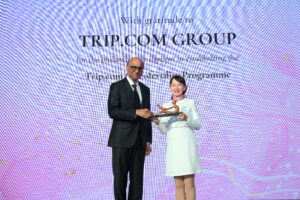
Jane Sun receiving a token of appreciation from Tharman Shanmugaratnam, President of the Republic of Singapore, at the KKH O&G Centenary Celebration Dinner 2024

Sun sees travel as a force for good—a way to connect people and uplift communities. But her commitment goes beyond enabling exploration; it includes initiatives designed to deliver meaningful, lasting impact where it’s needed most.

In partnership with KK Women’s and Children’s Hospital in Singapore, the Group launched the Trip.com Oncofertility Programme Fund—an initiative that supports fertility preservation for young women undergoing cancer treatment, offering them hope for starting families in the future. Sun explains, “We believe in supporting initiatives that create real and lasting impact in people’s lives. The challenges faced by women diagnosed with cancer are profound and, through the donation, we are committed to helping them preserve the opportunity to build a family.”

Trip.com Group has also partnered with various organizations to support programs that uplift children from low-income families. These initiatives include curated outings to attractions such as Christmas Wonderland during the festive season, Rainforest Wild Asia and the Singapore River Cruise, among others.

Employees also regularly volunteer with community programs, such as distributing care packs containing daily essentials to residents living in government-subsidized rental housing across Singapore.

Sun’s commitment to paying it forward was, to a large extent, shaped by her experiences as a student in the United States. During her time at the University of Florida, Law Professor Fletcher Baldwin and his wife, Dr. Nancy Baldwin, graciously offered her a place to stay and cared for her with exceptional kindness. Deeply moved by their generosity, Sun promised to one day repay them, vowing—in keeping with traditional Asian values of filial piety—to care for them in their old age. However, the Baldwins encouraged her instead to extend that goodwill by helping others in need. In 2016, Sun and her husband, John Wu, honored their legacy by donating US$3 million to the University of Florida’s Levin College of Law and Warrington College of Business.

“We firmly believe in the importance of paying it forward and supporting the less privileged members of the community. We want to do more to support women and children,” Sun says, “so that everyone can move forward together regardless of their background.”

Reimagining Travel, Inspiring the World
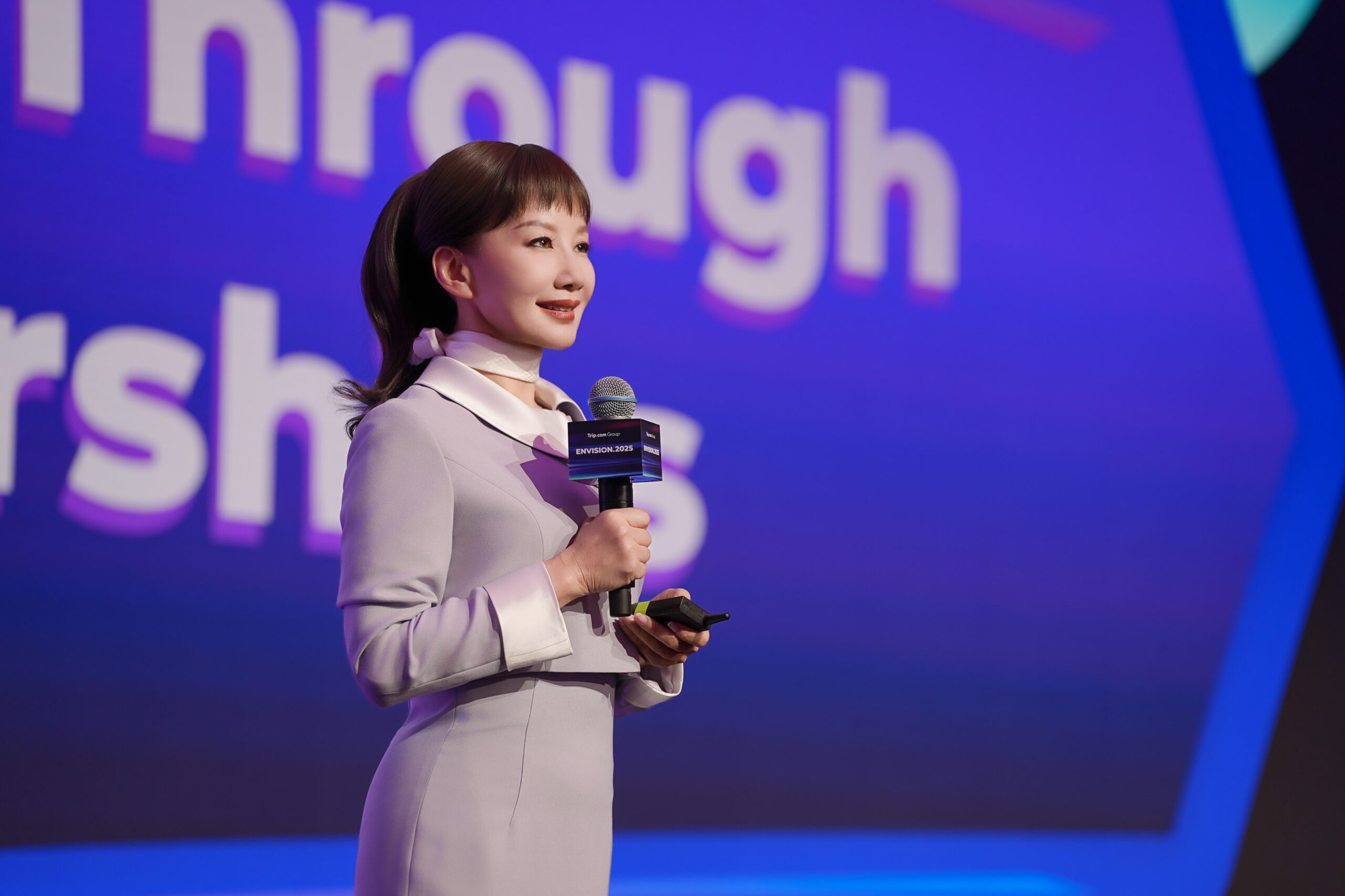
Jane Sun addressing more than 3,000 partners at Envision 2025 Global Partner Conference

Sun is at a pivotal moment in her journey. Having rebounded strongly from the pandemic, global travel and tourism is surging—with international arrivals and tourism receipts reaching record highs, and with no signs of slowing down. Under her leadership, Trip.com Group is at the forefront of this growth.

In the second quarter of 2025, Trip.com, the Group’s international OTA platform, reported an increase in overall reservations of over 60% year-on-year. This growth reflects both the resilience of established markets and the potential of untapped opportunities across new regions and segments. In key markets, the Group’s outbound booking numbers exceeded 120% of pre-pandemic numbers and inbound travel bookings were up by over 100% year-on-year.

Sun attributes this strong performance to Trip.com Group’s unwavering commitment to providing the best experience to its customers.

Looking ahead, Sun sees a horizon full of opportunity. As travelers seek more personalized experiences, and emerging destinations draw new interest, she is reimagining the entire travel experience, innovating to deliver seamless, engaging and tailored journeys, crafting the perfect trip for every customer.

“The next five to 10 years hold enormous potential for the global travel market,” says Sun. “With our strong brand and innovative services, we are proud to lead the way in shaping the future of travel.”

For Sun, the pursuit of the perfect trip is part of a broader vision—one where travel connects people, bridges cultures and inspires a better world.

She is deeply conscious of how she can use her own position to make a difference, both within Trip.com Group and beyond. “I’m one of the very few female CEOs in high-tech, and I feel passionate about paving the way for other women,” she says. “Imagine if half of our global leaders reflected the diversity of the population. Perhaps we could approach the world’s challenges with greater empathy and peace. We’ve made progress—but the potential is far from realized.”

Guided by this vision, Sun sees Trip.com Group not just shaping the next generation of travel, but contributing to a future where exploration, opportunity and discovery come together to create lasting, positive change.

“The perfect trip—for every traveler, every journey and a better world. That’s what we’re building.”


From Power Grids To Jet Fuel: How Public-Private Partnerships Can Unlock Asia’s Low-Carbon Future

Across Asia-Pacific, more than 350 million people have limited access to electricity, while 150 million have none at all. Southeast Asia’s (SEA) power needs will more than double by 2050 compared to 2022, while global electricity use from data centers is expected to exceed twice the current levels by 2030.

The convergence of electrification, industrialization and digitalization means Asia faces a potential energy crisis: how to expand access while simultaneously decarbonizing. The region cannot meet this challenge through government action alone. While the private sector has both the capital and the capacity to accelerate solutions, it must work hand-in-hand with policymakers.

Anderson Tanoto, Managing Director at RGE, with global operations in the bio-based resources and energy sectors, explains: “No single country, company or institution can deliver the energy transition on its own. The private sector brings innovation, capital and speed; governments provide vision and enabling frameworks. Together, we can build an energy system that is sustainable, inclusive and built to last.”

RGE and TotalEnergies signed an MoU to develop a utility-scale solar project in Riau, Indonesia.

Partnerships That Scale Impact

Energy transition requires collaboration that crosses industries and borders. RGE’s joint venture with TotalEnergies, Singa Renewables, shows what is possible. Supported by the governments of Indonesia and Singapore, the partnership is developing a utility-scale solar and battery energy storage system in Riau, Indonesia.

When operational, the project will supply green electricity to both Indonesia and Singapore while stimulating investments, creating skilled jobs and strengthening regional energy security. The collaboration marries RGE’s deep local roots with TotalEnergies’ global expertise in utility-scale renewables.

Singapore’s Energy Market Authority has already granted Singa Renewables a conditional license for up to 1 gigawatt (GW) of solar energy from Indonesia, a step aligned with Singapore’s target of 6 GW of low-carbon imports by 2035. Building on this, RGE and TotalEnergies signed an agreement with Singapore Energy Interconnections to co-develop a subsea interconnector, a vital step toward the ASEAN Power Grid, which aims to strengthen cross-border electricity trade and accelerate an equitable transition.

A rendering of Apical’s sustainable aviation fuel facility in Spain

Innovation Beyond Electricity

The transition extends beyond power generation. RGE is advancing a waste-to-value strategy by transforming waste and residues from its agribusiness Apical’s global supply chain into sustainable aviation fuel (SAF). Through Apical, it has partnered with Spain’s Moeve to build Southern Europe’s largest SAF plant. Scheduled to be operational in 2026, the facility will produce 500,000 tonnes of SAF annually, reducing carbon emissions by up to 80% compared to conventional jet fuel.

In parallel, RGE is investing in liquefied natural gas (LNG) as a transition fuel. Together with Canada’s Enbridge Inc., it is developing Woodfibre LNG, the world’s first net zero LNG export facility, in British Columbia.

Tanoto notes: “The toughest sectors to decarbonize demand innovation and collaboration on multiple fronts—and the private sector can scale and share expertise across regions.”

Unlocking SEA’s Renewable Potential

The International Renewable Energy Agency (IRENA) estimates SEA’s renewable potential to be 40 to 50 times greater than its current electricity generation. But scale requires more than ambition. Derisking large-scale projects is critical to attracting capital and accelerating deployment.

Governments hold the keys by setting clear, consistent policies that endure beyond political cycles, establishing supportive regulations and cross-border agreements, and designing mandates and targeted subsidies to overcome first-mover risks.

Private players, meanwhile, must manage risks within their control: access to land, building enabling infrastructure, proving technical feasibility, and ensuring benefits flow equitably across markets. Shared value is essential for regional buy-in.

From Ambition to Action

Asia’s energy transition is not just an environmental imperative; it is an economic one. Reliable, low-carbon energy underpins growth, competitiveness and social inclusion.

RGE’s experience shows that commercial viability and long-term impact can go hand in hand. With scale, innovation and cross-border collaboration, the private sector can unlock the capital and expertise to complement government leadership.

Says Tanoto: “Energy is the foundation of progress. If Asia can expand access while decarbonizing, we won’t just meet demand. We will define how economies can grow sustainably, inclusively and competitively for generations to come.”

www.rgei.com


Shifting Supply Chains Fuel Demand for Faster Asia-Europe Links

FedEx delivers swift, reliable shipping solutions for businesses worldwide.

As businesses recalibrate their supply chains in response to geopolitical shifts and regulatory changes, the Asia-Europe trade lane is gaining importance.

Europe is ASEAN’s third-largest trading partner, with trade volumes driven by sectors such as healthcare, retail fashion, high-tech and industrial goods, fueling both B2B and B2C flows between the two regions.

Looking ahead, ASEAN’s exports are projected to increase by around 90% by 2031, far outpacing global trade growth of under 30%. Meanwhile, Asia’s share of global GDP is expected to rise from around 55% today to nearly 58% by 2030.

Much of the growth is being driven by key manufacturing and innovation hubs across Southeast Asia. Vietnam has emerged as a leading exporter of electronics, while Malaysia plays a critical role in the global semiconductor supply chain.

These markets, along with Thailand’s strong automotive production and Singapore’s advanced logistics and biomedical sectors, are anchoring Southeast Asia’s contribution to the region’s export growth.

This robust trade activity along the Asia-Europe lane will continue to fuel growing demand for reliable cross-continental shipping solutions. FedEx is positioning itself at the heart of this momentum, off ering a faster, more connected logistics network to help businesses respond to changing market dynamics and capitalize on emerging opportunities.

“By leveraging our agile network, we’re enabling businesses across Asia to tap into faster, more direct access to key European markets.” Kawal Preet President, APAC, FedEx

“Trade flow patterns are never static. We’re constantly monitoring how supply chains are shifting so we can anticipate what’s next and stay ahead of our customers’ needs. Trade between Asia and Europe is becoming more diverse and multidirectional. Asia is not only exporting a broader range of high-value goods—it’s also emerging as a significant consumer of European products. By leveraging our agile network, we’re enabling businesses across Asia to tap into faster, more direct access to key European markets,” says Kawal Preet, President, APAC, FedEx.

To meet growing demand, FedEx introduced a new flight route last year connecting its Asia-Pacific hub in Guangzhou to Bengaluru, through to the UAE, Liège and Paris, further enhancing connectivity between China, India, the Middle East and Europe. Operating five times a week, the route offers greater flexibility and faster delivery for customers across this critical trade lane.

FedEx has also streamlined the export clearance process for high-value shipments from South China, improving delivery speed and operational efficiency across the region.

Within Europe, businesses can take advantage of FedEx’s integrated air-and-road infrastructure. Anchored by key logistics hubs in Paris, France; Cologne, Germany; and Liege, Belgium, the network supports over 550 pick-up and delivery stations across 45 countries and territories, and facilitates the sorting of more than two million packages every day. The company’s road network is also one of the fastest in Europe, enabling quick deliveries across the region.

“Our European network is a powerful backbone for global trade, designed for speed, scale and reliability,” Preet adds.

Amid shifting trade dynamics between Asia and Europe, businesses are seeking faster, more reliable ways to move goods across borders. FedEx is meeting this demand with expanded routes, integrated infrastructure, and by helping customers reimagine their supply chains through digital transformation and AI tools. These tools, including touchless, frictionless clearance, drive unparalleled resilience, efficiency and scalability for businesses. From pickup to delivery, FedEx embeds intelligence and automation into its air and ground network, making logistics smarter and more predictable. With advanced technology, FedEx is creating a flexible and efficient system that helps customers adapt to changing market conditions and opens doors to new growth.

Preet says: “Customers today demand end-to-end visibility, flexibility and control. That’s why we’re continuously advancing our network and leveraging technology to meet these expectations. We are building smarter, more resilient logistics infrastructure that enables sustainable growth and seamless trade between Asia and Europe.”

Expanding Horizons: NX Group’s Role In Global Logistics

NIPPON EXPRESS HOLDINGS President Satoshi Horikiri aims to make NX Group one of the top five players in the international freight industry.

In recent years, pandemic-related port closures, the conflict in Ukraine and now the threat of new U.S. tariffs have resulted in significant challenges to global supply chains. But behind the scenes, logistics companies are ensuring that important shipments are getting to where they need to be on time. One of them is NX Group, which is leveraging leading-edge technology and strategic acquisitions to establish itself as one of the top five players in the international freight industry. NIPPON EXPRESS HOLDINGS President Satoshi Horikiri talks about the company’s growth in the global market.

A Foundation Built on Trust and Technological Advances

Established in 1937, Nippon Express, the core company of NX Group, has roots that go back to 1872, a time when Japan began a rapid program of modernization. The company was founded by merging rail and other transport companies, immediately giving it a multimodal advantage. After quickly expanding across Japan and internationally, mainly in B2B logistics, NX Group built a reputation as a precision-oriented, flexible partner trustworthy enough to ship masterpieces like the Mona Lisa and the Venus de Milo around the world.

As of 2023, NX Group has a significant 25% share of Japan’s air exports, and is currently ranked 8th in air freight, 6th in sea freight and 6th overall.

NX Group has introduced warehouse AI and cloud-connected autonomous mobile robots that transport inventory to loading bays.

“Our strength lies in our leading presence in Asia, with Japan as the core of our operations,” says Horikiri. “Asia accounts for a significant portion of global cargo volume, with some 60–70% of global cargo originating from the region. Another source of strength is our combination of freight forwarding and logistics. Based on account management, we can provide the right solution for every customer.”

Supporting this position is NX Group’s deployment of leading-edge logistics technology. It has introduced warehouse AI and cloud-connected autonomous mobile robots (AMRs) that transport inventory to loading bays. NX Group has established systems that provide real-time cargo tracking and digital monitoring of temperature and impact on cargo, as well as forklifts with remote, autonomous and manual operating modes.

“We have started a pilot project called the NX Universal Harmonious Work Warehouse, a place where people of all abilities can work in a supportive environment that incorporates short-distance mobility solutions. This is the first phase of a workplace evolution to create a better environment for everyone,” says Horikiri. “I believe these innovations have boosted distribution efficiency and helped NX Group better serve its customers.”

Leveraging M&As to Fuel Customer Growth

NX Group now includes over 300 companies and more than 78,000 employees working in 57 countries and regions all over the world.

With a focus on key industries, including semiconductor, healthcare and automotive, NX Group now includes over 300 companies and more than 78,000 employees working in 57 countries and regions all over the world. Over the past decade, NX Group, which values a customer-oriented approach, has grown into a company that can create even greater value by attracting companies with the same philosophy to join the group.

“The goal of this strategy is not only to increase global scale but also to support customers as they enter new markets,” says Horikiri. “Mergers and acquisitions increase purchasing power for transportation, leading to expanded capabilities and more solutions for customer challenges.

One example is expanding a network in Eastern Europe and a customer base outside Japan. In 2024, NIPPON EXPRESS HOLDINGS acquired cargo-partner, an Austrian logistics company with a strong presence in Central and Eastern Europe. Established in 1983, cargo-partner specializes in air and ocean freight forwarding and offers services in rail and truck transportation, as well as contract logistics.

Commenting on the value of this acquisition Horikiri says, “It brings key synergies: a strong transportation network in Central and Eastern Europe, complementary customer bases for cross-selling and enhanced efficiency through combined cargo volumes, integrated operations and shared back-office functions.

NX Group has started a pilot project called the NX Universal Harmonious Work Warehouse, where people of all abilities can work while using short-distance mobility solutions.

In another example aimed at increasing competitiveness and efficiency, NIPPON EXPRESS HOLDINGS acquired the Simon Hegele Group, a German contract logistics provider, in 2025. Founded in 1920, Simon Hegele specializes in logistics services for the healthcare industry and has over 2,800 employees and operations across Europe, the U.S., South America, Asia and Australia.

“Simon Hegele has built a robust customer base by leveraging its specialized logistics platform,” says Horikiri. “It has strength in healthcare and transportation networks within the EU. By integrating with NX Group’s forwarding functions, it will create synergies and provide end-to-end services from transportation to delivery and installation.”

“Cargo-partner and Simon Hegele are very customer-oriented companies whose corporate culture resonates with our DNA,” Horikiri says. “We’re confident that the service and quality we have built in Japan, our home market, will be welcomed by Western companies. Recently, foreign companies that used our services in Japan really liked them and expressed a desire to use them globally.”

As NX Group brings its Japanese sensibility of attention to detail, precision logistics and innovative end-to-end solutions to serve a broader scale of businesses overseas, it will leverage both its technological expertise and its ability to deal with the unexpected.

“M&As increase purchasing power for transportation, leading to expanded capabilities and more solutions for customer challenges,” says Horikiri.

Maintaining Focus on Customer-Oriented Solutions

Recently, due to geopolitical risks, flying over Russia and sailing through the Red Sea have become challenging. Even outside of conflict zones, there are cases where regulations in various countries are suddenly tightened, or domestic disasters cut off roads. Logistics is a global industry, and irregular situations occur constantly.

“NX Group’s motto, ‘We find the way,’ reflects the company’s commitment to overcoming logistics challenges and providing optimal solutions tailored to each individual customer,” says Horikiri. “It shows our commitment to finding the best transportation solutions, meeting our customers’ challenges and seeing them through. This customer-centric approach is what drives NX Group’s global business expansion and enables us to provide high-quality services that are closely aligned with our customers’ needs.”

Talent Development, A Necessity In A Changing Context

Véronique Tran, Executive Vice-President, ESCP Business School (Photo by Emmanuel Fradin)

How does the current context challenge businesses and organizations?
VT : Adaptability is inherent to business and the lives of organizations, which have always had to evolve in order to survive. However, the scale of today’s economic, societal and environmental upheavals—such as the need to rethink growth in a world with finite resources, the growing polarization of opinions or even the arrival of new generations—implies real paradigm shifts on the part of companies and individuals, leaders and managers. Knowing how to change ways of thinking is therefore crucial.

Why is such a development necessary?
VT : Every organization is subject to inertia and resistance to change. And yet, the need to evolve is inevitable. Take AI, where current developments require us to rethink certain processes to improve performance. However, we must keep in mind that AI remains a tool that must be taken advantage of and not a universal remedy. Our role as a global business school is to provide companies, managers and directors with the tools to understand the contexts in which they operate. That’s why our executive education courses include geopolitics and sustainability modules in addition to our technical lessons—to help them be more flexible and resilient, and “stay relevant” in the words of Steve Jobs.

How does ESCP approach talent development?
VT : To be sure, our mission as a school is to deliver knowledge, but it is above all to teach how to learn. Thanks to ESCP’s unique multi-campus model and international approach, one of our fundamental lessons is to take into account different business contexts. This, coupled with a strong research drive, helps us accomplish what I consider to be an essential goal : shaking up learners, and encouraging them to “unlearn” to better embrace new ways of doing business and seeing the world. Of course, academic expertise remains key, as do some of our convictions, particularly on the issue of sustainability, for which we encourage our learners to reflect and act upon the impacts. ESCP thus offers courses that combine theory and practice, where learners exchange their experiences and learn from each other, and during which both alumni and professional experts provide their testimonies and experiences. By enabling us to better understand our environment and developing talent, training helps us to manage change, which I believe is inevitable given the major transformations we face.

      To learn more about ESCP Business School, visit escp.eu


Tech And Innovation Drive The Next Chapter For Thailand’s CP Group

Suphachai Chearavanont, Senior Vice Chair and CEO of CP Group

From its humble roots, Charoen Pokphand Group Co., Ltd. (CP Group) has grown to become Thailand’s largest private multinational company, with businesses spanning agriculture, food, retail, telecommunications, pharmaceuticals, finance and banking. For over a century, the group has managed to survive and thrive, adapting to changing business realities along the way.

Today, as new technologies and customer expectations redefine the business landscape globally, CP Group is not only embracing these changes but turning them into opportunities for growth and diversification. By fostering innovation on all fronts and utilizing technology in a meaningful way, the company recognizes that rapid evolution is key to its competitiveness in the long run.

Leading these efforts is CP Group’s Senior Vice Chair and CEO Suphachai Chearavanont. “Businesses today are facing the trends of digitalization, decarbonization and deglobalization, which are testing how quickly they can adapt,” he says. “These are having a profound impact on every aspect of our lives and business operations.” In response, CP Group is investing in artificial intelligence (AI) and data capabilities, reducing carbon emissions and deepening regional ties to support resilient supply chains.

“Technology is critical for remaining competitive and ensuring future growth and resilience. We invest in and develop innovative technologies to enhance our customer experience, create meaningful value for the communities we serve and increase our efficiency,” Chearavanont says. “This is core to who we are.”

This references the company’s long-standing and deeply embedded “Three Benefits Principle,” which states that the business benefits first the communities it engages with, then the countries it operates in and finally the company itself.

“To drive meaningful change, digital initiatives must align with the strategic direction of the group and of our individual businesses,” he adds, stressing the need to balance the company’s immediate needs with its long-term vision. “We have progressed well because we are adopting technology with purpose—in a way that is clearly aligned with the business we want to build.”

Innovation at its Heart

Innovation has always been central to the company’s strategy, dating back to its humble beginnings as a small seed trading company in 1921. The Airplane brand seeds sold at the shop were the first agricultural products to carry a quality guarantee. In 1959, the business started vegetable seed experimental farming, and by 1970, it had pioneered the use of rearing house management technology and poultry farming with Arbor Acres chickens, then considered the world’s best chicken breed. In 1973, it built Southeast Asia’s largest and most modern feed mill. This spirit of innovation has endured over the years, leading it to achieve one milestone after another.

Today, CP Group has eight business lines across 14 business groups. Over 60% of its revenue comes from overseas operations in 21 countries, where it has manufacturing plants, livestock farms, retail stores, distribution centers, hypermarkets, supermarkets, mini supermarkets, and research and development centers. In 2023, the group reported total revenue of 3.32 trillion baht (US$100 billion).

“We are continuously learning, evolving and embracing change. Over the past century, we have been fortunate to grow and adapt to changing consumer needs across our lines of business,” Chearavanont says. “The digital evolution is the next chapter and one that we have been embracing and championing across the group and across society.”

AI and Advanced Technologies

AI and advanced technologies have a crucial role to play in both social and economic development. CP Group has been exploring the potential applications of AI for some time now, leveraging the technology across several essential areas of its business—ranging from precision farming and supply chain optimization to customer insights and predictive analytics in retail and finance.

In retail, for instance, AI helps CP Group understand customer preferences better, resulting in personalized products and services that resonate with individual needs. In healthcare, AI is improving access to healthcare and outcomes for communities. The MorDee telehealth app by CP Group’s telecom-tech arm True Corporation (True) demonstrates this by using AI to connect users with doctors best suited to their symptoms, analyze health data for personalized treatment options, and help patients obtain prescriptions and file their insurance claims quickly.

At CP Foods, a CP Group subsidiary, AI is utilized in agriculture to provide data-driven insights that help the company increase crop yields, manage resources sustainably and reduce waste. This aligns with its broader goals of improving food security and addressing climate challenges. 

The use of AI in animal husbandry is also a transformative step for CP Foods. For example, AI helps detect health issues in animals early, reducing the need for antibiotics and improving food safety and quality. 

Chearavanont believes that the most impactful technologies in the food sector will be those that contribute to solving global and local challenges like food security by addressing specific issues across the food value chain, from farm to table. “I think these will be related to advanced data analytics, automation, biology and energy,” he says.

Sustainability and innovation go hand in hand.

Blockchain, for instance, enables the company to securely trace its fresh poultry, pork and shrimp products at every step of their journey to the consumer. This enhances food safety and supply chain efficiency while allowing the company to verify sustainability compliance. Innovative concepts in food, such as probiotic-fed and chemical-free animal products, are also paving the way for safer, more nutritious options and more sustainable production.

Furthermore, zero-waste systems, like converting waste into fertilizer, and the Internet of Things, such as sensors and smart cameras to monitor animal health and optimize feeding, help the company move closer to achieving a circular economy.

“We are deploying innovative ways to create a regenerative business model that builds sustainability, resource efficiency and waste minimization across our food supply chain,” says Chearavanont.

This includes improving equipment and manufacturing processes to reduce food loss and repurpose byproducts, such as making fishmeal from fish trimmings not fit for human consumption and producing organic fertilizers from eggshells generated by its poultry business, which would otherwise be disposed of. By using this organic fertilizer produced in its crop farming, the company reduces the need for chemical fertilizers and enhances soil health.

Chearavanont adds: “We are also moving toward recyclable, biodegradable and reusable packaging materials and making significant investments in renewable energy, including solar and biomass, for our operations.”

In 2023, Chearavanont introduced the Sustainable Intelligence (SI) principle within CP Group. “SI ensures that we are wise and purposeful when embracing advanced technologies. We must make sure that we remain rooted in ethical principles with a deep sense of responsibility to society. To do this, we must focus on preparing our people. This isn’t just about upskilling our own employees, but it’s also about educating underserved communities to ensure that no one is left behind,” Chearavanont says.

For CP Group, the private sector has a collective responsibility to work in partnership with the government and society to achieve this vision, and drive a digital transformation guided by a human-centered approach.

“By focusing on SI and AI, we can build a more just and equitable society, equipped to tackle global challenges and create lasting, positive impact,” he adds.

Through CONNEXT ED, CP Group is committed to supporting the younger generation.

Promoting Financial Inclusivity and Digital Literacy

Also gathering momentum is Ascend Money, a fintech firm established in 2013 under CP Group that has evolved from a digital wallet into a multi-service digital financial platform empowering people across the region.

“We recognized the critical need for greater financial inclusion and equitable economic growth in the region, and the powerful role that technology can play in tackling related challenges” says Chearavanont of its launch.

Ascend Money provides digital financial services to individuals and small businesses across the country, giving them the chance to take control of their financial future. This helps to reduce financial disparities, foster social mobility and alleviate poverty, which is aligned with CP Group’s “Three Benefits Principle” and demonstrates how the company is leveraging technology with clear purpose.

Meanwhile, the True Money app, offered by Ascend Money, is an e-wallet platform available in Thailand, Cambodia, Indonesia, Myanmar, the Philippines, Malaysia and Vietnam. With over 50 million users, the platform connects individuals and small businesses to the financial system across the region. These developments are essential as they allow businesses to grow beyond their domestic markets, facilitating smoother trade and boosting the digital economy.

For Chearavanont, cross-border financial solutions are key to unlocking the potential of Southeast Asia’s rapidly expanding digital economy, which has the potential to reach US$1 trillion by 2030.

“I believe that CP Group’s role in these developments goes beyond being a service provider. We are a partner in fostering a more inclusive and integrated regional economy,” Chearavanont says. “We will continue to work with governments and stakeholders to ensure that our technologies support the growth and sustainability of ASEAN’s digital financial infrastructure.”

The public is encouraged to report burning incidents through the F-Farm app.

The Path to Sustainability

Sustainability and innovation go hand-in-hand, and integrating them is essential for the group’s future growth and resilience. This year, True aims to reduce greenhouse gas emissions and energy consumption by up to 15% per network site, thanks to predictive AI. Additionally, True plans to install solar panels at up to 11,200 sites and data centers, saving an estimated 64,000 MWh of electricity annually.

CP Foods is also set to reduce 100,000 tons of carbon dioxide equivalent each year through a reformulated animal feed, following the Food and Agriculture Organization’s Climate Smart Agriculture Framework. Its Thai Rice NAMA project, in collaboration with the governments of Thailand, Germany and the United Kingdom, has trained tens of thousands of Thai rice farmers in low emission farming techniques, significantly reducing methane emissions. CP Foods has also mobilized multiple stakeholders to address PM 2.5 dust pollution—caused by fine inhalable particles with diameters that are generally 2.5 micrometers or smaller—by using satellite imaging to monitor crop burning while encouraging the public to report burning incidents through its F-Farm app.

“Our goal is to be carbon neutral by 2030 and net zero by 2050. There is still some way to go but we believe we are making good progress,” says Chearavanont.

Workforce of the Future

Key to CP Group’s vision of being a leading technology-driven company known for pioneering innovative solutions to global and local challenges is the ability to nurture a culture of continuous learning and innovation.

In Chearavanont’s words, “We must stay open and curious—internally and externally, empowering our people through training and educational initiatives that develop their tech fluency and entrepreneurial capabilities.”

Through its talented workforce, CP Group has more than 7,500 patents registered for innovations and inventions, furthering its impact globally. It is also collaborating with a growing network of partners and together they are continuously exploring ideas and technological solutions to address critical issues such as food security, financial inclusion, sustainability initiatives and healthcare access.

CP Leadership Institute trains thousands of employees every year.

One of its flagship internal initiatives is the establishment of the CP Leadership Institute, where 4,000 employees are trained annually. The program emphasizes not only technical skills but also critical thinking and problem-solving capabilities. It also connects the organization’s leaders with its people across the group, helping to prepare them for a future at CP Group while encouraging a deeper sense of engagement.

As the Senior Chairman of the Digital Council of Thailand (DCT), Chearavanont also recognizes that digital literacy is key to not only CP Group’s long-term competitiveness but also the country’s. To accelerate Thailand’s digital transformation, DCT focuses on initiatives that enhance the nation’s digital infrastructure, support government digital ecosystems and nurture a digitally skilled workforce. The council is advocating for the establishment of a national board of transformation to help Thailand stay competitive and to oversee and integrate digital transformation policies across sectors. This will bolster the country’s growth, from digital literacy across the workforce to strengthening Thailand as an innovation hub.

“It’s a combined effort. Our partnerships with public and private sectors, as well as educational institutions and tech companies, will help accelerate our progress into Thailand’s 5.0 era,” says Chearavanont.

CP Group’s entrepreneurial roots give it a natural inclination to support innovation and industry disruption. True Digital Park, one of Southeast Asia’s largest tech and startup hubs, brings together more than 5,800 players from around the world in an integrated ecosystem, convening investors, innovators and industry leaders to collaborate and share knowledge. This fosters talent growth and the development of innovative solutions.

CP Group also champions CONNEXT ED, a nationwide public-private partnership set up to address educational challenges in the country. Chearavanont emphasized that the group is committed to supporting the younger generation—the driving force for the future of the nation and the world.

Guided by its “Three Benefits Principle” and a vision for sustainable innovation, CP Group is not just poised to help take Thailand into the 5.0 era, but to shape a future where technology and responsibility go hand in hand—creating lasting value for communities, countries and the world.


www.cpgroupglobal.com

Ascend Money: Catalyst For Change

Tanyapong Thamavaranukupt, Co-President of Ascend Money

Thailand’s first fintech unicorn Ascend Money Co., Ltd, having secured fresh funding of close to US$200 million recently, is laser-focused on growing its business to the next level by providing a wide range of financial services to the underserved and unserved segments.

Tanyapong Thamavaranukupt, Co-President of Ascend Money, the operator of TrueMoney, says the company has enjoyed tremendous growth since it was established more than 10 years ago.

More importantly, it has evolved from a digital wallet into a multi-service digital financial platform that empowers people and promotes financial inclusivity.

Humble Beginnings

Ascend Money’s journey to become Southeast Asia’s leading fintech platform started in 2013 as a unit of e-commerce firm Ascend Group, which is a spinoff from True Corp., one of Thailand’s top telecom operators. Today, Ascend Group operates as a subsidiary of conglomerate Charoen Pokphand Group Company (CP Group).

In its early days, Ascend Money’s core business was in payment processing, operating under the TrueMoney brand. At that time, the company found that avid gamers, who were mainly students and young adults, were having difficulty acquiring gaming credits.

“We saw the pain point they faced. They wanted to buy gaming credits during the wee hours, but there was nothing available online, and shops that sold these credits were closed,” says Thamavaranukupt. “So, we launched our first e-wallet app, allowing them to buy gaming credits using their prepaid credit cards.”

Ascend Money then started to expand TrueMoney’s payment use cases. It teamed up with convenience store chain 7-Eleven to enable customers to buy credits for mobile app store purchases.

On top of that, it continuously worked on improving the user experience of TrueMoney and, subsequently, evolved into a digital financial superapp—one that allows users to pay their utility and credit card bills, top up their mobile phone credits, and save and invest.

Thamavaranukupt says TrueMoney had only 200,000 monthly active users during its first year of operation. Today, it has about 20 million.

Despite the impressive growth, Thamavaranukupt believes the achievement is only the tip of the iceberg. “We want at least half of Thailand’s population, about 30 to 35 million, to use TrueMoney regularly within three years,” he says.

Achieving Unicorn Status

In 2021, Ascend Money raised US$150 million from a group of investors, including existing investors CP Group and China’s Ant Group, and new investor Bow Wave Capital Management, a U.S. investment firm. It was a major milestone for Ascend Money as it achieved the US$1.5 billion valuation as a result of the funding round, making it the first fintech company in Thailand to achieve unicorn status.

Thamavaranukupt says the company did not rest on its laurels and continued to develop and improve its suite of financial services for the underserved segment.

These efforts caught the eye of Mitsubishi UFJ Financial Group, Inc. (MUFG). The Tokyo-based financial group, through its subsidiary MUFG Bank, was the lead investor in a US$195 million funding round. Finnoventure Private Equity Trust 1, managed by Thailand’s KrungsriFinnovate Co., Ltd., was also an investor in this round.

These investments will help Ascend Money accelerate its plan to provide inclusive financial services for underserved consumers and micro, small and medium enterprises (MSMEs), fostering equitable economic growth and financial well-being in Thailand, Thamavaranukupt says.

“MUFG is a serious investor and having the company onboard raises the profile of Ascend Money. It has a good track record in investments in Southeast Asia. The dynamics between us and MUFG are good. They understand the region well and they understand our business,” he adds.

Serving the Underserved

While Ascend Money, through its TrueMoney app, has features that are catered to the masses and across different income groups, the company’s key strengths lie in promoting inclusivity and developing products to serve the underserved segments.

Although about 95% of Thais have bank accounts, Thamavaranukupt says, many do not have access to loan financing. “Only 5% to 7% of bank customers have their loan applications approved,” he states.

Most of the Thai adult population is underserved because many of them are self employed and do not have regular incomes. “This makes it challenging for traditional banks to evaluate their actual financial health, their ability to service loans and approve loan applications,” he says.

As part of Ascend Money’s mission to help address the needs of the underserved, Thamavaranukupt says the company started to expand from providing payment solutions to offering financial services as early as three years ago.

“There were two objectives for the decision. First, to serve the underserved. Second, since the profit margin in the payment business is very slim, we have to expand to other services in order to grow,” he explains.

Giving the Underserved Access to Financing

In 2016, Ascend Money launched Ascend Nano, a new business that provides micro credit and personal loan products to the underserved community.

Using state-of-the-art technology and  alternative data, Ascend Nano helps customers and MSME owners gain access to loan financing. Ascend Nano is able to identify “good customers” using its revolutionary credit score software, which is now in its  fourth version.

The company works with its partners to better understand customers’ behavior. “In this business, it is all about risk management. We examine their behavior when using mobile phones and mobile wallets, and use the data to determine their credit score and credit line,” Thamavaranukupt says.

The company also reduced its risks by providing customers with a small credit line, especially new customers. “If they have the capacity to repay the loan on time, we will be able to provide them with a bigger loan,” he explains.

He adds that while the credit lines may appear small, they can impact customers’ lives. “A majority of our customers need the money for emergencies, such as health issues or children’s education. They have the ability to repay the loan; it is just that they lack access.”

Today, about 78% of Ascend Nano’s customers are those who have either never received bank loan approvals or have had their loan applications rejected. “What we are doing here is new and revolutionary.

Our approach to credit is very different from the traditional players,” Thamavaranukupt points out.

Democratizing Wealth Products

Despite a population of over 70 million, Thailand has a relatively low investment penetration, with only 3 to 4 million Thais having investment accounts.

The low penetration rate also means that the lower-income group—which constitutes the underserved segment—does not have access to investment products. To provide the underserved with investment products, Ascend Money launched a mutual fund investment service on the TrueMoney app, enabling users to open investment accounts online. Users can browse various mutual fund options, including those that allow them to start investing with as little as 1 baht (US$0.029), offering an easy opportunity to learn through experience.

Another highlight investment product is gold saving. This service allows customers to buy gold for as low as 100 baht (US$2.93) via the TrueMoney app.

While gold investment may not be as “sexy” as stocks or mutual funds, Thamavaranukupt believes it is a product suited to the underserved segment.  “Gold is something that many of us, across all income groups, understand well. For the low-income group, gold is typically their first form of investment. When they have excess cash, they buy gold.”

So far, this product has been well-received by customers. “We already have a few million users investing in gold. We are seeing growth in this segment.”

Besides mutual funds and gold investment, TrueMoney users are also able to invest in various assets, such as government bonds with tenures as short as three months. Nevertheless, Thamavaranukupt says there’s still a lot of work that needs to be done in this area, as there’s still a long way to go before hitting critical mass. “Investors’ awareness and education play a big role. Customers need to understand the importance of having long-term investments.” 

Providing Peace of Mind

Another area that Ascend Money aims to address is insurance protection for the under served. According to Thamavaranukupt, many Thais understand the importance of  having insurance coverage, but affordability is the main barrier. The average worker cannot afford annual premiums, which, in most cases, are required to be paid in a lump sum.

To make insurance more affordable for Thais, Ascend Money, via Ascend Assurance, has come up with “bite-sized insurance plans.”

“There are about 20 million motorcycles in Thailand, but most do not have insurance coverage, which typically costs around 3,000 baht (US$88) annually. The lower-income group cannot afford to pay this amount in one lump sum. So, we break it into a monthly premium of 250 baht (US$7), and it will be auto-deducted from their TrueMoney wallet,” Thamavaranukupt says.

Today, Ascend Money has one million customers buying insurance through its platform the company claims, and plans are underway to introduce more insurance products.

Strengthening Regional Presence

Seeing the growth potential of the Southeast Asia market, a region with a population of over 673 million, Ascend Money has been gradually expanding its presence across the region since 2016. While Ascend Money focuses on multiple products and business streams in Thailand, the company’s main focus in the overseas market is on TrueMoney.

Unlike in Thailand, where people can send money to one another using the TrueMoney app, such flexibility does not extend to all Southeast Asian countries due to regulatory reasons.

In some countries such as Cambodia, Indonesia, Myanmar, Philippines, Malaysia and Vietnam, TrueMoney users would need to go through an agent to perform domestic and cross-border money transfers.

Today, it has more than 88,000 agents in Southeast Asia, over 50 million users, and has processed payments of more than US$14 billion.

Over the long-term, Ascend Money’s game plan is to achieve synergy between its business in Thailand and across the region. “For example, we have the TrueMoney app in Cambodia. Cambodians can come to Thailand and make payments using their local TrueMoney app on our system, and vice versa,” Thamavaranukupt says.

He adds that plans are underway to ensure user experience is seamless across Southeast Asia.

Future Plans

What makes Ascend Money’s business model interesting is that each of its core products—payments, insurance, investments and micro loans—can synergize with one another. For example: A customer who owns gold via Ascend Wealth could one day use it as collateral to apply for a loan.

Thamavaranukupt notes there are similar plans in the pipeline. “Pawn broking is a big business in Thailand and it is an area we are exploring. We feel that we can digitize certain segments of the pawn business,” he says.

Nevertheless, Thamavaranukupt says it is important to remain focused on the company’s immediate goal—for TrueMoney to achieve 30 million monthly active users within the next three years.

“There are a few hurdles when it comes to the adoption curve. We have crossed the early adopter hurdle, and we are now on the verge of crossing the early majority hurdle. Having said that, it will be challenging, as people are used to making payments via the conventional method, or another digital platform,” he remarks. “We will have to continue to build and improve our platform, improve the stickiness and at the same time create digital awareness.”

He adds that there is still lots of room for growth across all business segments.

“For payments, we want to make TrueMoney an everyday payment app of choice. In terms of lending, we have spent the past two years working on the credit score model. I think we are good to go now, and we expect to grow faster in the next three years.”

Building Culture, Startup Mindset

Thamavaranukupt admits that having the right people and a committed team is crucial to Ascend Money’s success today, and in order to build a good team one needs to have a good company in place.

“In terms of building a culture, we set out four key values. First, we are committed to make a positive impact and to deliver beyond expectations. We focus on our mission, and we communicate this to everyone in the company,” Thamavaranukupt says.

The second value involves building a harmonious team. “We don’t want silos or boundaries. We respect clear communication. I believe good teamwork is important for a company’s success.”

At Ascend Money, curiosity is highly encouraged. “We want everyone to always be curious. We want them to be curious about their work, and how they can serve customers better.”

“Fourth, is to maintain the startup spirit. At Ascend Money, there is no hierarchy, we do not have many layers of management. Everyone can share their thoughts and discuss issues. I think this is very important,” Thamavaranukupt says.

He adds that by having the right culture in place, the company is able to reduce its employee turnover rate significantly. Five years ago, its turnover rate was 50% annually. “Today, most of our staff have been with us for more than five years.”

Constantly on its Toes

Although Ascend Money has built a strong foundation and company culture, and has grown into a leading digital finance player in Southeast Asia, Thamavaranukupt under stands that it is vital for him and his team to be constantly aware of the responsibilities they are shouldering.

“We have a very big platform,” he states. Therefore, the security of the platform, the stability and reliability of the platform are essential.”

Thamavaranukupt says the company invests heavily in technology and 55% of its employees are in tech-related roles. “We understand that in this business, the reputation we have built over the years can we have built over the years can disappear overnight if we are not careful.”

    Ascend Money at a Glance
  • Ascend Money was established in 2013 as a unit of e-commerce firm Ascend Group, which is a spinoff from telecom firm True Corp. At that time, True Corp was 62.5% owned by Thai conglomerate Charoen Pokphand Group Company Limited (CP Group).
  • Today, Ascend Group operates as a subsidiary of CP Group.
  • Based in Bangkok, CP Group is Thailand’s largest private company controlled by the Chearavanont family, ranked No. 2 on the 2024 Forbes list of Thailand’s 50 Richest, with a net worth of US$29 billion.
   Ascend Money has Four Main Businesses
  • Payments
    Ascend Money’s payment business is operated under the brand TrueMoney. Started as a payment services provider for avid gamers who wanted to buy gaming credits, TrueMoney has grown and evolved into a multi-purpose mobile wallet. Users can use TrueMoney to pay utility bills, invest in mutual funds, sign up for buy-now, pay-later schemes, and more.
  • Lending
    The lending business is operated under the company called Ascend Nano. It provides nano finance and personal loan products to the underserved who need flexibility in order to grow.
  • Investment
    Operated under the company Ascend Wealth, it gives low-income communities and young adults access to investment products. For example, customers can buy gold for as low as 100 baht (US$2.93).
  • Insurance
    The insurance business is operated by Ascend Assurance. It is the newest product line offered by Ascend Money.

5 Ways To Discover New Experiences With The Platinum Card

The Platinum Card® by American Express presents a world of special privileges and experiences. With worldwide priority lounge access, a rewards program tailored to your lifestyle, travel benefits and personalized services, The Platinum Card is designed for those who are accustomed to the finer things in life.

But are you making the most of your membership benefits? Here are five ways to fully utilize your Platinum Card perks in Singapore.

#1 Elevate your staycation with a room upgrade and more

Capella Singapore

Looking for a quick break but short on time? A staycation is the perfect solution to rest and recharge. With The Platinum Card, you will score elite tier membership status with leading hotel loyalty programs such as the Pan Pacific DISCOVERY, Marriott Bonvoy and Hilton Honors. This means you will instantly access the premium tiers of these programs upon enrollment and enjoy perks like complimentary room upgrades, early check-in and late check-out.

Stay two or more consecutive nights at any property in The Hotel Collection and snag a complimentary room upgrade (if available) and US$100 in amenity credits. Use them for dining, spa treatments, golf or other experiences.

What’s more, if you book at one of the Fine Hotels + Resorts—such as Capella Singapore or The Ritz-Carlton, Millenia Singapore—you will get up to S$800 (US$592) in benefits. Enjoy complimentary daily breakfast for two and US$100 amenity credits, ranging from spa credit to food and beverage treats.

These fantastic perks are bound to make any staycation that much sweeter, whether it’s a romantic escape or downtime with the family.

#2 Snag exclusive invites to Platinum events

Live it up like a VIP at exclusive invitation-only events, from timepieces and fashion shows to fine dining, art exhibitions and performances. Fashion enthusiasts can look forward to sneak peeks of new collections from top luxury brands such as Panerai, Mont Blanc and more. Plus, be among the first to place orders for the latest luxury pieces before they hit the stores in Singapore.

Keep abreast of the latest trends in the world of beauty, fragrances and cosmetics at closed door events and masterclasses hosted by your favorite brands.

These specially curated experiences can be found on the Amex Experiences app. Browse and book your preferred Platinum events conveniently in one place.

#3 Refresh your wardrobe and curate your wine collection

Grand Cru, Wine Concierge

Savvy shoppers, it’s time to refresh your wardrobe with some of the most coveted buys of the season.

Get that newly released designer handbag or timeless piece with your S$150 (US$111) complimentary fashion credit at NET-APORTER or MR PORTER. You can also apply for the Sands LifeStyle Prestige membership, without the usual prerequisite spend of S$5,000 (US$3,700) in a calendar year. With this membership, you can enjoy exclusive shopping, dining and other privileges at Marina Bay Sands.

That’s not all, as part of the Lifestyle Credit benefit, you will also receive S$400 (US$296) back in statement credit when you spend at least S$600 (US$444) in a single transaction at Grand Cru Wine Concierge. Choose from a curated selection of highly rated wines from Burgundy, Bordeaux and other top winemaking regions to add to your collection.

Looking to reap bigger rewards when you shop?

Earn 20 Membership Rewards® points on your first S$16,000 (US$11,800) spent with Platinum 10Xcelerator partners in Singapore, spanning fashion, home and lifestyle, beauty and cosmetics, watches and jewelry. The best part? These points never expire. Plus, you can use Pay with Points + to offset payments and redeem your Membership Rewards points for travel, including hotel stays and flights.

#4 Dine at the hottest restaurants

Restaurant JAG

Love eating out? Get 100% enjoyment at half the bill with the Love Dining program. Enjoy a sumptuous meal at selected hotels and restaurants specially curated by Platinum and save up to 50% on your total food bill. For an elevated experience, Platinum offers the Love Dining Experience. With this program, you can enjoy special touches when you visit participating restaurants.

At Michelin-starred Restaurant JAG, diners are treated to French flavors featuring the season’s finest ingredients. As part of the Platinum Special, you will receive a complimentary aperitif, hot beverages and a seasonal gift, among others. Plus, you will have the chance to meet the chef (subject to availability).

Make your restaurant bookings online or through the Platinum Concierge and get ready for a truly unforgettable dining experience.

#5 Begin your journey in style at the airport lounge

Retreat from the airport crowd and begin your trip in luxury and ease. As a Platinum Member, you have access to the Global Lounge Collection®, which includes lounges at Changi Airport and over 1,400 airport lounges spanning 650 cities worldwide. Whether you are looking to catch up on work or grab a quick bite, enjoy the amenities at American Express’ growing network of lounges.

The SATS Premier Lounges, conveniently located in Terminals 1, 2 and 3 of Singapore Changi Airport, offer an array of amenities, including massage chairs and a delectable buffet spread paired with a wide selection of alcoholic and non-alcoholic beverages. You can bring one guest to enjoy these complimentary perks.

Ready to live it up? Get your Platinum Card and unlock these rewards.


The benefits mentioned in this article pertain to The Platinum Card issued in Singapore. For cards issued in other countries, please visit their respective websites.

FedEx Enhances Logistics Experience With Leading-Edge Innovation

By integrating digital solutions with its physical network, FedEx is delivering a customer experience that meets the dynamic needs of businesses and consumers alike.

In 2024, the air cargo industry has shown resilience, particularly in the Asia-Pacific region. Major trade lanes, such as Asia-Africa and Asia-Europe, have seen significant increases in demand, contributing to the growth momentum in the region.

A significant factor driving air cargo demand is the flourishing e-commerce sector, with global online sales expected to reach US$6.3 trillion by 2024. With many of the world’s biggest e commerce import and export markets located in Asia-Pacific, the region is at the heart of this rapid expansion. Asia-Pacific holds a one-third share of the global air cargo market, the highest of any region worldwide.

To cope with this projected growth, as well as the increasing complexity of managing international logistics, businesses today are demanding efficiency, transparency and reliability in their supply chain operations.

This requires solutions that offer companies hyper-personalized delivery experiences, predictive analytics for proactive issue resolution, and seamless integration with their existing digital ecosystems. This shift pushes logistics providers to not just meet basic service expectations but leverage advanced technologies to offer more nuanced and sophisticated solutions.

“Conventional supply chains have been turned on their heads in recent years multiple times over. The pandemic, economic slowdowns, geopolitics, demands for sustainability and gigantic leaps in technology and AI are all now integrated into our customers’ planning, modeling, and response times. Being agile and responsive, to enhance competitive advantages and capture new opportunities wherever they emerge is critical in meeting our customers’ needs,” says Kawal Preet, President, Asia Pacific at FedEx.

FedEx is utilizing leading-edge technology to deliver value-added solutions that not only help businesses overcome supply chain challenges but enable them to capitalize on emerging opportunities by enhancing their overall logistics capabilities.

The company’s approach to digital innovation is underpinned by an understanding of its customers’ needs, which guides its investments and development of technological solutions to support them.

Blending Digital With Physical

By integrating digital solutions with its physical network, FedEx is delivering a customer experience that meets the dynamic needs of businesses and consumers alike.

“FedEx has always innovated to solve customer problems. Today, technology is absolutely critical to making supply chains work smarter and more efficiently for everyone,” says Preet.

Central to FedEx’s strategy is the use of advanced data analytics to improve logistics experience. For instance, the FedEx Dataworks team employs machine learning, artificial intelligence and other sophisticated analytical methods to streamline processes, predict potential issues and provide real-time decision-making support.

This data-driven approach enables FedEx to offer seamless and efficient services, significantly reducing delays and improving reliability.

FedEx is also enhancing the ability of its customers to have control and visibility over their shipments with FedEx Surround®, an intelligent solution for monitoring and intervention designed to elevate logistics and supply chain management. It uses SenseAware ID, an advanced sensor-based technology designed to provide near real-time visibility into package location and condition. This innovative solution uses Bluetooth technology to transmit precise location data, enabling customers to track their shipments with unprecedented accuracy.

“With data-backed intelligent solutions like FedEx Surround®, we are building smart logistics for our customers. The tools are not just about tracking; it’s about smartly intervening in real-time to ensure that shipments are not only monitored but also actively managed to mitigate risks. This is a game-changer for businesses relying on just-in-time delivery and high-stakes shipments,” adds Preet.

Furthermore, FedEx has introduced industry-leading last mile solutions such as “picture proof of delivery” that offers customers peace of mind, confirming that their packages have been delivered securely. Customers can also communicate directly with FedEx through WhatsApp, making the delivery process more interactive and customer-friendly.

Innovating to Meet Evolving Needs

With a deep understanding of the changing needs of businesses, FedEx continues to innovate to provide access to digital solutions that drive operational efficiency and customer satisfaction. Another example of this commitment is the launch of the fdx platform, an end-to-end e-commerce solution designed to help SMEs grow demand, optimize order fulfillment and streamline returns.

The fdx platform integrates the company’s extensive physical transportation network with advanced digital capabilities to offer real-time visibility and connected capabilities, allowing merchants to make strategic logistics decisions.

“Ultimately, by using technology and ever greater amounts of connected, continuous and contextual data, we are transforming the way we operate. The pace at which we are developing digital solutions is only going to accelerate,” says Preet.

fedex.com/sg

Setting Its Sights On Further Growth

Jonathan Quek, Managing Director of BreadTalk Group

As a child, Jonathan Quek and his siblings spent their weekends trailing their parents on site visits to various outlets of the F&B business they had founded. In 2000, George Quek and Katherine Lee started that enterprise, BreadTalk, with just one outlet in Singapore selling signature items such as their now-famous “Flosss” buns.

BreadTalk has since grown into a leading F&B group that is home to a stable of well-known brands, with around 660 outlets across 14 international markets in Asia, the Middle East and the U.K. The company directly owns brands such as BreadTalk, Toast Box and Food Republic, and the franchise rights for partner brands like Taiwanese restaurant chain Din Tai Fung in Singapore, Thailand and the U.K.

The Quek family holds a 74.9% stake in the BreadTalk Group through their investment firm, while Thai multinational Minor International owns the remaining 25.1%.

Quek’s early exposure to the family business laid the groundwork for his understanding of the industry’s dynamics. From his parents, he learnt the importance of paying attention to detail, engaging deeply with customers and being a hands-on manager.

After completing his higher education in London, Quek returned to Singapore amid the Covid-19 pandemic to join BreadTalk Group. “We saw that our parents were busy fighting the crisis, so it was natural for my siblings and me to come aboard to help out in any way we could,” says Quek, who is now 29 years old.

Despite being the bosses’ son, there was no corner office waiting for Quek when he started in 2020. Rather, his first job was at a suburban BreadTalk outlet where he handled everything from cashiering to serving customers. This on-the-ground experience was critical in helping him understand the day-to-day challenges of running the business.

Over the next two years, he rose up the company’s ranks to manage eight, then 40 stores. By 2023, he was promoted to Managing Director, overseeing the bakery division and its 160 outlets across Singapore and Thailand. Quek’s older sister, Joselle, heads the group’s R&D efforts, while his younger brother, Matthew, runs the restaurant division.

Quek’s management style during the pandemic highlighted his capacity to lead with compassion, as he focused on alleviating staff burdens and enhancing their job security and workplace conditions. He is also known for being approachable and responsive, qualities that have fostered a strong, collaborative environment in the teams he leads.

Emerging Stronger from Crisis

To deal with the fallout from the pandemic, the BreadTalk Group revitalized its product lineup by introducing items tailored to changing consumer preferences. The group also streamlined its operations by employing new technology to reduce costs and improve efficiency.

BreadTalk redesigned its store layouts at major shopping malls, including Westgate, NEX, Raffles City and Plaza Singapura, to enhance the customer experience, making them more modern and inviting to a younger audience.

Learning from its pandemic experience, the company also sought to reduce its reliance on the retail channel by introducing consumer products that are based on the group’s signature items such as kaya, coffee and cookies from its various brands. The products are sold at supermarkets or through e-commerce platforms.

These strategic adjustments, combined with a focused expansion in both existing and new markets while maintaining high standards of quality and consistency, propelled BreadTalk Group to register close to S$600 million (US$446 million) in revenue in 2023.

Looking ahead, the group has set its sights on an even more ambitious target of hitting S$1 billion (US$738 million) in revenue by 2029. “We are still mindful when it comes to expansion. We want to maintain that financial prudence, and be more selective in how we expand,” Quek says.

Food Republic, Din Tai Fung and Toast Box are among the brands under the BreadTalk Group.

Betting Big on Innovation

A big part of the BreadTalk Group’s success in recent years has boiled down to its pursuit of innovation across its operations. The group’s R&D efforts have introduced fusion products like the “Crookie,” a blend of a croissant and a cookie, capturing the fancy of Gen Z and millennial consumers. The R&D team continuously scouts for viral trends and popular flavors that resonate with a global audience and integrate these insights into their product
development process.

BreadTalk has also embraced technology to ramp up its productivity in the face of rising costs and a tight labor market. For instance, the group introduced new equipment at one of its production departments to increase its capacity. This centralized department now supplies to all BreadTalk outlets, improving quality and product consistency across all its stores, while reducing the brand’s reliance on manpower.

Catering to Local Tastes

To expand globally, BreadTalk Group employs a strategy that combines direct ownership and franchising to ensure that its core offerings remain consistent across all markets, while also adapting to local tastes. Singapore currently contributes the majority of the group’s revenue, with Greater China the next largest contributor.

Around 80% of the products offered in the group’s overseas markets are made up of its signature items, while the remaining 20% are dedicated to variations designed for local preferences. For instance, one of BreadTalk’s bestsellers in Thailand is a yam coconut bun, which combines fragrant Thai ingredients. Meanwhile, at Taiwanese eatery Din Tai Fung’s outlet in London, British beef is used in its signature dumplings. The U.K. restaurant also features a bar, which has proven to be popular among local patrons; alcoholic beverages now account for a significant proportion of its sales.

“We try to find ways to incorporate local ingredients into our products to cater to local tastes and celebrate the culture,” says Quek.

Expanding its Global Footprint

The BreadTalk Group continues to seek global expansion, with an eye on new markets such as North America and Australia, as well as accelerating growth in India. In its established markets, the group plans to add four to five Din Tai Fung restaurants in London, supplementing the existing three. The group also sees the potential for significant growth in Thailand and China.

To fund its expansion, BreadTalk may return to the equity markets via an initial public offering in the future. The company had initially listed on the Singapore Exchange in 2003, before privatizing in 2020.

The potential listing would provide the company with the financial resources it requires to accelerate its entry into new markets, fund innovation in product development and enhance the customer experience.

Says Quek: “We want to keep the momentum going, and raising capital from the markets is one way to help us expand quickly. Having different investors who have different experiences and backgrounds will also be helpful.”

www.breadtalk.com