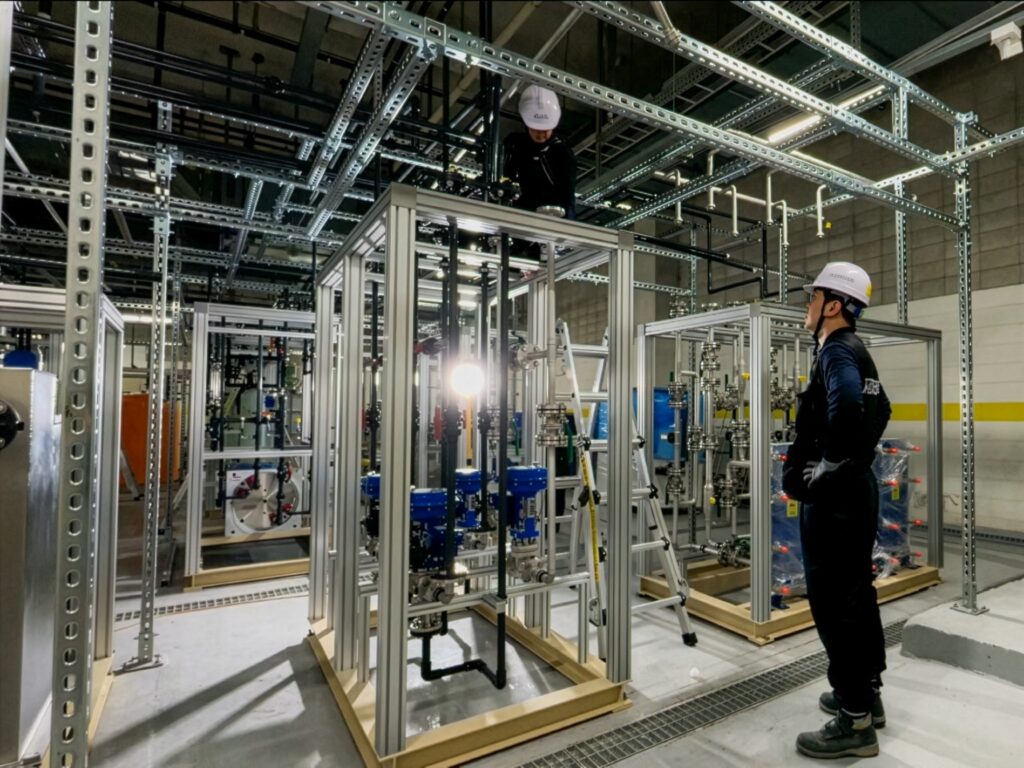
Samsung Electronics and SK hynix recently confirmed plans to invest roughly 800 trillion won (US$533 billion) in four new memory fabrication plants in South Korea’s Honam region, the largest geographic shift in the country’s chip industry in decades. Weeks later, President Lee Jae Myung convened an AI summit in San Francisco with the chief executives of Nvidia, OpenAI, Anthropic and Broadcom, positioning South Korea as a core link in the global AI supply chain.
Every fab in that plan arrives with a water problem attached. Ultrapure water is used to rinse silicon wafers between chemical processing steps, and a single stray particle can ruin an entire wafer lot. An advanced fab consumes tens of thousands of tons of water a day, and a cluster of the scale planned for Honam cannot draw indefinitely on conventional sources. How that region secures its water may prove as consequential as how quickly the plants are built.
Customization as a Core Competence
South Korean advanced water technology specialist GnG InTech works on exactly that question. Founded in 2001, the firm says it has delivered more than 160 projects across semiconductor, display, component and other precision industries, and its customers range from mid-sized suppliers to leading Korean chipmakers and global semiconductor equipment manufacturers.
It operates as a full-scope engineering house rather than an equipment vendor, handling design, procurement, construction, commissioning and long-term operations under a single contract. That structure matters most when something goes wrong. Water-quality failures rarely trace back to one component. They come from how the whole system works together, from pretreatment and membranes to the final polishing loop, the piping and the way the plant is run each day. When separate vendors handle each piece, they tend to blame one another. A single responsible partner does not have that option.
Customization, not a fixed product line, is the company’s core competence. Some clients need water at the outer edge of what is physically achievable. Others need less, delivered reliably at a defensible cost. At the top of its range, GnG InTech’s proprietary technology removes more than 99.999% of impurities, maintains resistivity above 18.2 MΩ·cm at 25 degrees Celsius, and keeps total organic carbon and dissolved gases below one part per billion, the company says. The team has also localized boron removal, a notoriously stubborn step, bringing that element down to parts per trillion.
Those capabilities brought the company a government-backed contract with K-water, the state-owned utility, to build an integrated industrial-scale ultrapure water facility. They also earned it a role in a public-private research consortium alongside major semiconductor players, universities and government institutes. The two are now working together on a national research program to produce ultrapure water from reclaimed municipal wastewater. The project has no formal tie to the Honam cluster today, but the connection is not hard to draw.
“Recycling industrial wastewater alone won’t close the gap at a site that size,” says Jinwook Chung, Chief Technology Officer at GnG InTech. “Municipal effluent is the biggest source nobody is really using, so some clusters like that will end up drawing on both. The hard part is the trace organics. Conventional reuse systems don’t remove them and mostly don’t even measure them, and that’s the gap between industrial-grade and wafer-grade water. Whoever solves that economically will sit underneath Korea’s next generation of fabs.”
Expanding Its Reach
Investors have taken notice. The company raised a Series A round in May 2026 backed by domestic venture firms and the Industrial Bank of Korea, and says revenue is on track to grow by more than 40% this year.
It is now deepening its work with global manufacturers, with Southeast Asia’s semiconductor and advanced manufacturing hubs as its immediate target. The company is courting buyers at SEMICON Southeast Asia, Singapore International Water Week and SEMICON West in the U.S., and recruiting regional engineering partners to anchor local operations and maintenance.
“Water is becoming one of the most important parts of chipmaking,” says Jamie Lee, CEO of GnG InTech. “Purity standards keep rising and technology has to rise with them. That’s why we’re building with local partners instead of selling through them.”
