In a world where artificial intelligence (AI) promises to reshape nearly every aspect of human life, one question looms larger than any technological milestone: What will give our lives meaning when machines do almost everything we do?
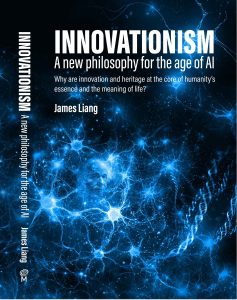
For James Liang, the answer lies not in resisting change but in reimagining humanity’s fundamental purpose. In Innovationism: A New Philosophy for the Age of AI, released earlier this year, he argues that creating new knowledge and ideas must become humanity’s central goal.
The Innovation Imperative
“Life needs a purpose,” Liang says plainly. “And innovation is the answer.”
It is a deceptively simple statement from a man whose career bridges Silicon Valley entrepreneurship and rigorous academic research. Beneath that simplicity lies a comprehensive philosophy that challenges conventional thinking about work, population and what living a fulfilling life means in an era of rapid technological change.
“Many experts, Elon Musk among them, believe a significant number of jobs will disappear within 10 years. And almost all jobs could eventually vanish,” Liang notes. “What does humanity do then?”
Such a question would have seemed absurd just a generation ago. Throughout most of human history, survival itself provided sufficient purpose. But as AI and robotics advance, the elimination of traditional work is no longer a distant scenario but a looming reality demanding a reconsideration of the foundations of human value.
Innovation as Compass
Liang’s response, detailed in Innovationism, is as philosophical as it is practical. He argues that innovation—the creation of new ideas, products, experiences and knowledge—should become the central organizing principle of both individual lives and society.
“Historically, R&D or creative work involved less than 1% of the workforce,” Liang explains. “But this has changed rapidly in recent years. Innovation is the source of wealth today. The wealthiest companies, nations and individuals derive their advantage from innovation.”
Liang’s observations, backed by years of research and publications in journals such as Nature and the Journal of Political Economy, underscore that innovation’s importance goes beyond economics—it shapes how we find meaning in work and technological progress. That search for meaning is reflected in the way individuals organize their lives over time.
Lifestyle Shifts in the Age of AI
Liang notes that many young adults start by chasing life’s simple pleasures—travel, new experiences and meaningful moments. “If you look at young people today, their lifestyle changes follow a clear pattern,” he notes. “At the most basic level, people seek experiences. When they imagine a good life, they picture one filled with rich, diverse experiences.”
That mindset helps explain the global travel boom, an industry Liang knows intimately through his leadership at Trip.com Group.
Yet a life organized primarily around consumption, even of experiences, has its limits. “After you’ve experienced many things, you may enter a creative phase, where you want to build something of your own—a business, art or an activity—and share that experience with others,” he says.
At this juncture, something interesting happens. Creation starts pulling focus away from self-expression and toward shared impact, raising a larger question of purpose. For some, that impulse deepens into a drive to contribute something greater—work that expands human knowledge, capability and potential.
This is where the core challenge of Innovationism emerges. In a world where making things is no longer the hard part, innovation isn’t just about novelty; it’s about judgment—choosing what’s worth making based on what genuinely enhances human happiness and fulfillment.
And according to Liang, only humans can make that call.
Population as Strategy
If innovation is humanity’s central purpose, population is its foundation. This connection anchors Liang’s demographic research and activism.
Liang sees innovation not as a sudden, mysterious spark but as a function of scale, skill and connections. A nation’s capacity to innovate depends on three factors: how many people it has, how capable they are and how freely knowledge flows within and across its borders—a process in which institutions and networks play a crucial role, keeping ideas moving both at home and internationally and shaping how effectively a nation can innovate.
The logic is unforgiving: weaken any one factor, and innovation falters. A large population without education or openness produces little progress. Small nations can thrive if they invest in capability and foster exchange. Population, in this context, becomes a strategic resource—the foundation on which talent, collaboration and connectivity build breakthrough ideas.
“At the national level, innovation determines competitive advantage,” Liang adds. “The rivalry between the U.S. and China ultimately comes down to innovation capacity, and a key driver of that capacity is population—the size of the talent pool able to contribute to innovation.”
Recent data paints a worrying picture. Official Chinese government statistics show only 7.9 million births last year, half the number from eight years ago and well below historical peaks. China is hardly an outlier. Fertility rates are plummeting across most developed nations.
“We’re in a demographic collapse and it isn’t accidental,” Liang states bluntly. “Before AI, fertility was already declining as societies urbanized and individuals—especially women—gained greater control over education, careers and reproductive choices. AI is simply speeding up that process.”
Cheap Dopamine and Delayed Careers
This acceleration is already visible in the early stages of working life. Entry-level jobs are disappearing as machines absorb the routine tasks that once allowed young workers to earn while learning.
As the skills threshold for stable employment rises, training periods consequently lengthen and the burden of becoming job-ready shifts from firms to individuals. The result is more years spent studying, credentialing and preparing—precisely during prime childbearing years. In this sense, AI raises the cost and extends the period of building a career.
Technology compounds the challenge in other ways. Digital pastimes deliver what Liang calls “cheap dopamine,” through addictive short-form videos and virtual relationships, which often compete with real social interaction and family life. At the same time, the cost of raising children has risen sharply. “Education takes longer, competition is more intense and parents bear increasing costs and pressure,” he adds.
These forces shape population trends, but numbers alone do not determine a society’s innovative capacity. How societal structures and incentives support—or fail to support—those capable of innovating ultimately determines whether potential translates into progress.
The Limits of Supply and Demand
The problem, Liang is careful to clarify, is not one of resources—it’s one of coordination.
“This is not a scarcity problem. It’s an alignment issue. Misalignment across time, generations and geography,” he explains. “Markets alone cannot correct this. Governments must intervene.”
The problem is simple: parents pay the costs now while society reaps the benefits later. Individual decisions to postpone or forgo children can make perfect sense in isolation but produce collective outcomes that threaten society’s future.
“What is misaligned,” Liang argues, “is not desire but values; we celebrate the benefits of future generations while asking individual families to absorb the costs alone.”
Policy Experiments
This insight has driven Liang from analysis into action. He recently launched the HK$500 million (US$64 million) Genovation Foundation to address low fertility through research and advocacy. At Trip.com Group, Liang has implemented pioneering policies including baby bonuses, flexible work-from-home arrangements, additional holidays and assisted reproduction benefits.
And while many leaders are calling employees back to the office, Liang doubled down on remote work. He ran randomized experiments within his company, tracking productivity and outcomes, and found that working from home didn’t just maintain performance. In some cases, it improved it.
“Not every measure will suit every company, but flexibility, especially remote work, is something many can adopt,” he explains, underscoring a commitment to policies that support both work and family life.
Beyond the role of governments and corporations, Liang insists that individuals must also take a long-term view of their own lives and decisions, especially when it comes to family. “The costs of having children are immediate and obvious while the benefits are long-term and easily dismissed, especially if you grew up as an only child,” he acknowledges. But as life expectancy rises, the enduring significance of family comes into sharper focus. “Children create extended circles of connection, shared memories and purpose that can linger across decades,” he says.

Innovation as Life’s New Frontier
For Liang, innovation is more than a driver of progress—it is a guiding purpose for human life, giving meaning to work, creation and personal contribution in ways previously unimaginable. Throughout most of human history, the world changed slowly enough that one generation’s experience mirrored the last.
“Before the Industrial Revolution, philosophers didn’t see meaningful change within their lifetimes. Innovation simply wasn’t part of philosophy or considered a life purpose. The term ‘innovationism’ would have been meaningless,” he explains.
That has changed dramatically. The number of PhD students in China has been skyrocketing, now standing at roughly twice that of the U.S., Liang says, and the number is still growing. “About 2% to 3% of the cohort population in China will be PhD students in the near future,” Liang adds.
That figure covers only PhDs. When master’s graduates and other research roles are included, a remarkably large portion of the workforce is already involved in innovation.
The Human Hand in an AI World
Underlying Liang’s philosophy is a more fundamental concern: who will control the future—humans or AI? The answer determines not just our economic trajectory but whether humanity retains agency over its own destiny.
“Geoffrey Hinton recently said humans may be destined to lose control to AI, and that the best we can hope for is that AI treats us like children,” Liang points out. “It’s a chilling idea. We can’t know if AI will be a benevolent parent or not.”
Rather than accept this fate, Liang proposes a different path: “We need more humans capable of understanding and steering innovation.”
Innovation cannot be reduced to computation alone. Questions of what is worth building—what is good, beautiful, ethical or ultimately fulfilling—require human judgment, not algorithmic optimization.
A Compass for Uncertain Times
Liang’s Innovationism arrives at a critical crossroads. As AI capabilities accelerate and demographic trends threaten long-term growth, Liang offers a framework linking individual meaning with civilizational survival.
The stakes go far beyond markets or GDP. Innovation shapes the way we live, the choices we make and the future we leave behind. In an age when work can no longer provide the purpose it once did, his message is simple and direct: innovation is not simply an economic imperative. It’s a source of meaning for individuals and for humanity.
The challenge for leaders, he argues, is connecting the dots and seeing the full picture. AI strategy, talent development, work models and demographic trends are too often viewed and addressed in silos. “The companies and nations that will thrive are those that develop integrated strategies that nurture a larger, more capable population within innovation-friendly ecosystems,” Liang says.
Seeing the full picture is merely the first step; acting on it is far harder, because the investments required now yield rewards only in the distant future. But surrendering purpose and control to machines isn’t an alternative—it’s no future at all.
For leaders navigating uncertainty, for individuals questioning their purpose and for societies confronting demographic decline, Innovationism provides both a diagnosis and a prescription even as it challenges readers to reframe their understanding of progress. Whether Liang’s philosophy becomes a guiding framework for the AI age remains to be seen. But the questions he raises about meaning, population and human purpose are ones we can no longer afford to ignore.